Tuesday, November 17, 2015

Answer: Fake or real? How do you know?


Generally speaking... 

...how do you know if it's faked or real?  

These days, with wonderfully competent photo editing software, and the sheer number of people generating content, it's sometimes really hard to tell.  Let's tackle each of these Challenges one at a time.  


1.  Is this a faked photo?  If so, how can you tell?  (Be specific.)  


The obvious thing in the picture is the jet fighter in the upper left.  (Let's not start to wonder whether or not all of the buildings in the scene are actually just as they are...  But there's an implicit lesson here--don't get too distracted by the obvious bogosity in the image--more than one thing could be manipulated here.)  

But let's focus on the plane.  If you download the entire picture and zoom in a bit, this is what you see: 


I've added a couple of arrows to indicate the direction the light is falling.  The sun is clearly up and to the right of the plan (that's why the shadow is falling from the rudder onto the elevator).  Notice also that the sunlight makes a pretty sharp shadow; it's full sunlight on the plane.  

By contrast, let's take a look at the tower in closeup: 


Here you can barely see any shadow.  It's a diffuse light, still tinged with the rosy colors of sunrise (or sunset), a kind of light consistent with the time on the clock (although many such clocks are wrong).  In any case, as you can see by this small arrow, the shadow is barely there, and it's coming in from the left.  

So this picture is clearly a composite of two different photos.  Each piece of the picture is illuminated by a different source of light.  And in outdoor photography, all sunlight comes from the same direction.  (There are exceptions, but this isn't one of them.)  

As Luís pointed out (quite correctly), doing a Search-By-Image on just the subimage of the fighter matches up perfectly with this image of a F-16 fighter from the Hellenic Air Force during a solo demo flight at Tanagra Air Base, Greece


Remmij also spotted the roundel on the wing and tried to identify it.  It's hard to ID for sure, but it's not a US mark, and it's unlikely that any other country would be flying F-16s in a tight pivot around Philadelphia City Hall.  

Remmij ALSO spotted another indicator of being shopped:  A cursor left in the image!


So this image is clearly a FAKE! 


2.  How could you tell if these hotel reviews are true or faked?  

Review 1: Stayed here for two nights with my wife and golden retriever in a pet friendly room. All staff in the hotel are super friendly and helpful. Can't beat the location. Visiting our son at Dalhousie. We are traveling from Maine and have greatly enjoyed Halifax. If you are into jogging, you can leave hotel and make loop in the point.
Review 2: We only stayed for one night but I would have happily stayed here longer. The hotel is beautiful throughout. We upgraded our room for a good price and had a really nice king bed which was really comfy. We ordered room service too for breakfast and were very impressed how quickly the food came.
How do you start on a question like this?  How CAN you possibly determine is a hotel review is faked or not?  
If you think about it, there are many great reasons to write a fake review (of hotels, restaurants, music recordings, films... anything that people buy AND review will attract faked reviews).  
I started this question by searching for some background on how to detect faked reviews: 
Somewhat surprising, I found a web site (ReviewSkeptic.com)  that claims to do some processing of the language of a hotel review and then give you a score about how fake/deceptive (or not) it is!   (You can read the news release about ReviewSkeptic, or the research paper underlying the mechanism here, if you're up for the math involved.) 
Running these two reviews through ReviewSkeptic suggests that they're both real reviews.  That's encouraging, but could we do more? 
One obvious thing to do is to check other reviews by the same person.  By doing the obvious query (select the first sentence of the review and search for it), you'll find that this review was written by MarkB, a Level 2 TripAdvisor reviewer.  If you click on the TripAdvisor badge for him, you'll see he's written 6 reviews, 5 positive, 1 negative.  By following up on all of the reviews he's written, can see see they're all more-or-less in the same tone (and language patterns), and distributed around, not all focused on one place (as would be typical of someone who's doing intentional deception).  
The same analysis with the second review finds that Madeline75 , a Level 5 reviewer, has been writing reviews for 10 years on TripAdvisor and has written 59 reviews, scattered across lots of time and places. Again, the reviews are very similar in tone and language, and have a good distribution of opinions--some great, some terrible, just what you'd expect in real-life.  
I'd mark both of these hotel reviews as REAL! 

3.  In this political season, many quotations from famous people (e.g., the Founding Fathers) are being bandied about.  Which of these Jeffersonian quotes do you think is real OR fake
Quote 1: “Do you want to know who you are? Don't ask. Act! Action will delineate and define you."
Quote 2: “That the obliquity of the ecliptic, when these elephants lived, was so great as to include with the tropics all those reasons in which the bones are found." 
Quote 3:  “Gun control works great for the people who are law-abiding citizens and it does nothing for the criminals, and all it does is put the people at risk.”

Let's start with the obvious approach--just copying them into Google search and seeing what we find.  (Actually, what I'm going to do is to remove the quote marks to do my search--the word order preference of Google's search algorithm will find the quote, if it exists, and any near misses.)  For example: 

     [ Do you want to know who you are? Don't ask. Act! Action will delineate and define you ] 

The results are interesting.  There are lots of results that tell us that this IS a true Jefferson quotation.  However, the first result is from Monticello.org, which is (I checked--so should you), the official site of Monticello, the famous home of Thomas Jefferson.  The have a full page just on this quote, debunking it as an actual Jeffersonian saying.  They helpfully point out that they couldn't find it in all of the sources they checked (and they list the sources--a great practice if you're doing reporting on topics like this), but they DID find it in a Polish authors writings that were first published in 1988!  (Specifically, Witold Gombrowicz, 1988: Diary, Vol. II (Chicago: Northwestern University Press, 1988), 130.) 

There's so much business in fake Jefferson quotes that Monticello.org has done the world a service and written up a collection of their Rules of thumb on How to Spot a Fake  to determine if a Jefferson quote is real or not.  This page is basically an introduction to text style analysis, and well worth reading.  Among other things, Jefferson basically never used contractions--e.g., "don't" in the above quote, or the use of anachronistic language... such as "gun control."

Quote #1:  FAKE! 

Same trick with quote #2: 

      [ That the obliquity of the ecliptic, when these elephants lived, was so great as to include
          with the tropics all those reasons in which the bones are found ] 
  

This query leads straight to a Google Books result which is a compilation of Jefferson's writings.  The Portable Thomas Jefferson has exactly this passage.  (Actually, that whole page is really interesting to read. Jefferson had some fascinating ideas about what kinds of animals might exist in North America.)  

Quote #2:  REAL!   

When we do the same thing with the 3rd quotation, we quickly find that it's been widely discounted as a fake Jefferson quote, but is still being used in political speeches by Ben Carson, potential Republican candidate. 

Could he have just mangled a real Jefferson quote?  

That claimed quote uses the heavily loaded phrase "gun control."  If you're going to quote someone, and "gun control" is in the quotation, you're probably not going to get that part wrong.  

Let's try to figure out when "gun control" became a common phase.  In cases like this, the first thing I turn to is Google NGram.  Searching NGram for " gun control " gives us this graph: 


Since Google Books includes all of the writings of the Founding Fathers, if it had been a reasonably frequent phrase, it should have shown up in the chart.  But it seems that aside from the use of "gun control" during World Wars 1 and 2 (always in the context of how to guide and point real guns in battle), the modern use of the phrase "gun control" seems to have started in the late 1950s or early 1960s.  

A quick search for: 

     [ etymology "gun control" ] 

gave me a number of sources (e.g., WordOrigins.com on "gun control"), all of which seem to concur about the introduction of the phrase (in the modern sense) around 1960. 

But I thought I'd check a long-running newspaper archive for this as well.   I settled on the LA Times (after checking a couple), partly because they have a tradition of writing about "gun control" and also because they have a decent advanced search function that allows one to sort the results by "oldest first."  

Sure enough, running the search for "gun control" there on their papers from 1881 until 1981 showed exactly the same pattern--before 1960 it was about military fire control; after 1960, it's a political phrase about gun ownership.  

Based on these quick scans of the phrase over time, I'm going to conclude that this possible quotation isn't just mangled... 

... it's FAKE!  


Search Lessons


1. Pay attention to the angle of the light and shadows in photos.  Simple tricks like drawing in the light lines can tell you quickly if the photo has been composed out of pieces.  

2. Note the presence of identifying marks on suspect items.  There's no way a fighter with a Greek roundel on its wing would be buzzing Philly city hall. 

3. As always, searching for tools to help do analysis tasks is a great trick.  Before starting this Challenge, I had no idea that an analysis site like ReviewSkeptic existed.  Now I have another tool to verify / validate things.  

4.  Checking quotations is tricky: double and triple check your sources.  For these quotes we got lucky.  We found one in the writings of Thomas Jefferson, and were able to discount the others fairly easily.  But behind each bit of research is a deeper validation of the sites you're reading. Here, Monticello.org is a really authoritative site that gives excellent analyses (including source citations) for all their work.  In the case of the 3rd quote, I wanted multiple sources telling me that "gun control" was born (in the modern sense) around 1960.  It's a bit more work, but it's pretty compelling.  


Another Challenge tomorrow!  In the meanwhile... Search on!


--- 
Update: Regular Reader Passager points out in the comments that I have an error in my 3rd quote.  He writes that:  

"That the obliquity of the ecliptic, when these elephants lived, was so great as to include with the tropics all those reasons in which the bones are found" is fake. For the real quote you have to replace reasons by regions. Knowing a little astronomy, I noticed the phrase with "reasons" had absolutely no sense, just checked with "regions" on monticello.org and found the right quote.

Ah... Sorry about that.  I wish I were that clever.  It was just a typo on my part.  Moral of this story:  If you're going to write about real and fake, be careful to copyedit your prose with care! 


Monday, November 16, 2015

Delay of game...


Sorry folks, but it's been a busy few days, and I neglected to note that I'd be super-busy today.  

It's all good, but I didn't think to write up my Answer for today well ahead of time. Usually I get up early on Monday morning and write everything up for you.  But not today; I just plain ran out of time.  

On the other hand, I WILL be back tomorrow with the answer. 

Tide and time waits for no man.  

On the other hand, if you're in New Brunswick today and are free in the middle of the afternoon, I'm giving a fun talk at Rutgers. 

 "The Evolution of Literacy: How web search changes our understanding of knowledge" 

This will be at the School of Communication and Information,  2:30 - 4PM, Room 323, SC&I Building, 4 Huntington Street, Rutgers University, New Brunswick, NJ.  

More searching tomorrow.  Until then, stay literate... 


Wednesday, November 11, 2015

Search Challenge (11/11/15): Fake or real? How do you know?


Unfortunately... 

... people have been faking stories, photos, and claims for as long as humans have been around.  Of course now we're aided by technology, which sometimes makes these deceptions a bit more difficult to ferret out.  

Here's an early famously faked photograph:  


This is one of the images of the Cottingley Fairies.  

In 1920, a series of photos, supposedly taken by two young girls while playing in the garden, claimed to show that fairies really did exist. Even Arthur Conan Doyle, he of Sherlock Holmes fame, was taken in by the images.  To our eye, these seem extraordinarily obvious--yet at the time, photography was still a fairly new thing, and we hadn't become quite so accustomed to fakery.  

Fast forward to now, and we see even more photographic faking.  People are copying missiles in faked launches, or removing unsightly telephone wires.  So we need to learn a few skills in detecting what's real and what's not.  As you might suspect, I'm going to argue that we need better SearchResearch skills! 

So here are a couple of Challenges for the week.  We'll start with easy, and get harder as we go along. 

1.  Is this a faked photo?  If so, how can you tell?  (Be specific.)  


2.  How could you tell if these hotel reviews are true or faked?  

Review 1: Stayed here for two nights with my wife and golden retriever in a pet friendly room. All staff in the hotel are super friendly and helpful. Can't beat the location. Visiting our son at Dalhousie. We are traveling from Maine and have greatly enjoyed Halifax. If you are into jogging, you can leave hotel and make loop in the point.
Review 2: We only stayed for one night but I would have happily stayed here longer. The hotel is beautiful throughout. We upgraded our room for a good price and had a really nice king bed which was really comfy. We ordered room service too for breakfast and were very impressed how quickly the food came.

3.  In this political season, many quotations from famous people (e.g., the Founding Fathers) are being bandied about.  Which of these Jeffersonian quotes do you think is real OR fake

Quote 1: “Do you want to know who you are? Don't ask. Act! Action will delineate and define you."
Quote 2: “That the obliquity of the ecliptic, when these elephants lived, was so great as to include with the tropics all those reasons in which the bones are found." 
Quote 3:  “Gun control works great for the people who are law-abiding citizens and it does nothing for the criminals, and all it does is put the people at risk.”


As always, let us know how you figured these Challenges out!  

Search on! 


Monday, November 9, 2015

Answer: The story behind a beautiful white flower?


This was simpler than I thought...  

Although I'm intrigued by flowers and such, I didn't think that searching out the answer would be as simple as it was!  Seems to me that when I looked it up (a few years ago, admittedly), this was a much more difficult search.  Sheesh.  Kids these days have it SO easy!  


More seriously, I do get the distinct sense that many search Challenges ARE easier--which means that both the amount of good online content is growing and that the search systems are becoming better.  Hurrah! 

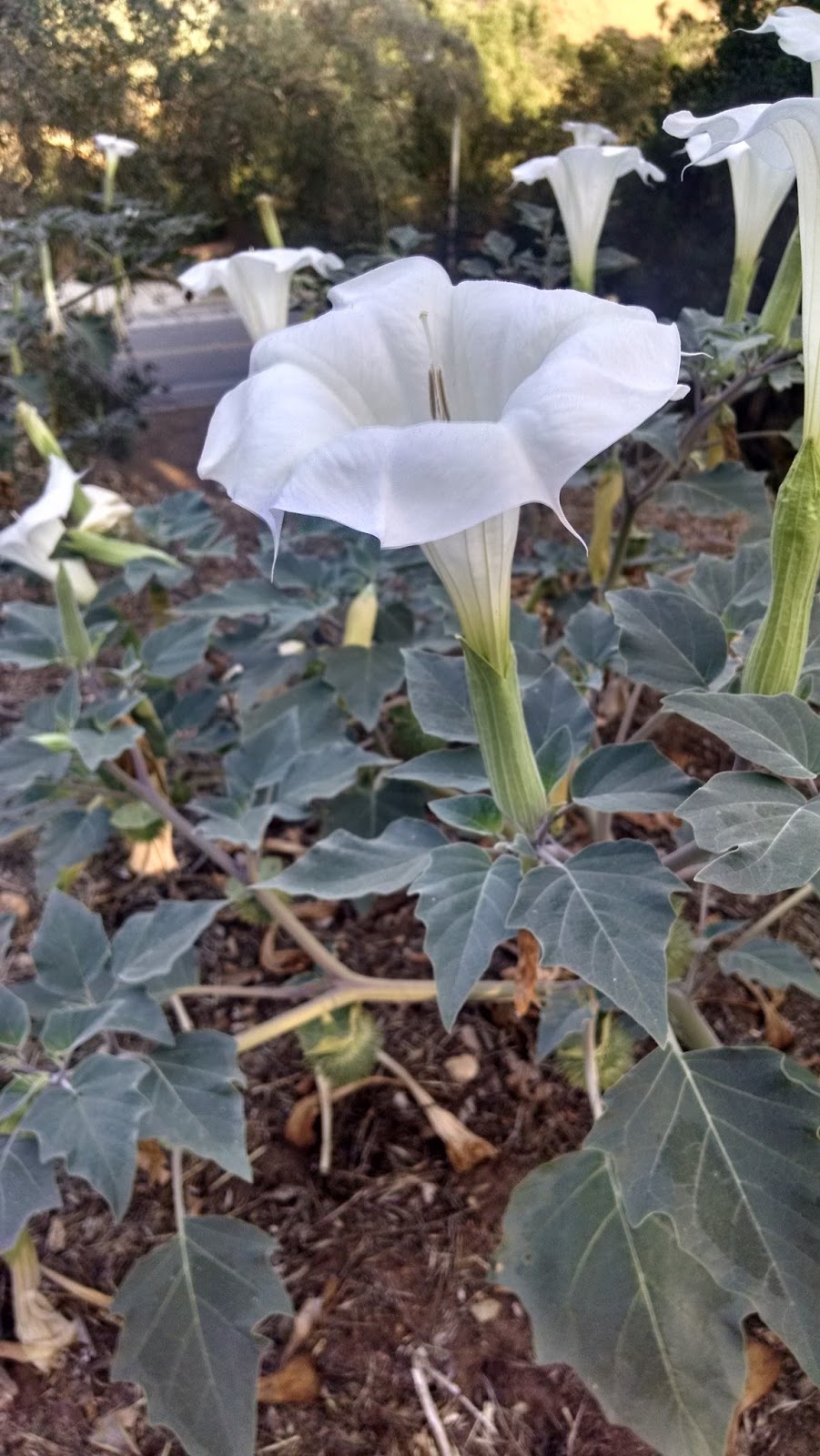
To recap the Challenge:  I found this flower in Southern California last July near the Santa Monica mountains.  It's a large and beautiful flower, maybe 4 inches across, and quite striking.    


Here are the Challenges:  

1.  What's the name of this plant?  (Both common and Latin names.) 

I was surprised when Ramón reported that regular Google Search-By-Image would work!  Since I'd taken the photo, I really didn't expect it to match with anything out there.  But if you do that search with the second image (with the filename "D2-ultra-closeup"), you'll get this: 


Clicking on the first image (upper left corner) takes you to a page about some of the flowers of New Mexico, where you learn that this is the flower of the Datura.  (And, incidentally, the state flower of New Mexico! I didn't know that.)  

A quick follow-up search on [ Datura ] and you'll find that it's a kind of nightshade.  In particular, Datura is a genus that contains nine species of poisonous flowering plants, all belonging to the family Solanaceae. (And Solanaceae has lots of plants that are potentially poisonous, but valuable--such as potatoes, eggplants, and some chilis.)  

There are many kinds of Datura, but the one that looks like this and grows in southern California is the Datura wrightii, which is also known as Jimson weed because of its resemblance to Datura stramonium.  Just so you'll know, all parts of Datura plants contain dangerous levels of anticholinergic tropane alkaloids and may be fatal if eaten by humans, livestock, or pets. In some places, it is prohibited to buy, sell or cultivate Datura plants. That regulation, of course, doesn't work well when it's a native plant that self-seeds fairly easily.  I've Datura everywhere from San Diego up through San José (near where I live in Northern California).  

The Georgia O'Keefe reference was to her famous work, "Jimson Weed" which shows four flowers of the Datura.  But it's also worth looking at her picture of the flower by itself:


2.  Is there a possible connection between this plant and zombies?  (I know, we should have had this question last week, just before Halloween...)  
Now that we know it's a Datura plant, we can do a simple search (which is remarkably like Ramón's search: 

     [ Datura AROUND(4) zombies


which gives us a link to an article in the Pharmaceutical Journal with the title: "Beware the psychedelic effects of the zombie cucumber"  in which we discover this sentence:  "But it has many other names, including locoweed, mad apple, hell’s bells, devil’s trumpet, mad hatter, devil’s snare, crazy tea and zombie cucumber — names that give an indication of its psychedelic effects." 

That article also includes a wonderful story from the early days of Jamestown:  


Although the plant was already known as James-town-weed at the time, the origin of the name is often attributed to an incident in the Jamestown area in 1676, when soldiers were sent to stop an armed rebellion against the rule of the colony’s governor. Needing to eat, the soldiers made a salad from local plants. The hallucinogenic properties of Datura stramonium soon took effect. 
(link to this story in Google Books
In ‘The history and present state of Virginia’ (1705), Robert Beverly wrote: “The plant was gather’d for a boil’d salad by some of the soldiers and some of them ate plentifully of it, the effect of which was a very pleasant comedy, for they turned natural fools upon it for several days: one would blow up a feather in the air; another would dart straws at it with much fury; and another, stark naked, was sitting up in a corner like a monkey, grinning and making mows [grimaces] at them; a fourth would fondly kiss and paw his companions, and sneer in their faces with a countenance more antic than any in a Dutch droll. 
In this frantic condition they were confined, lest they should, in their folly, destroy themselves — though it was observed that all their actions were full of innocence and good nature. Indeed they were not very cleanly; for they would have wallowed in their own excrements, if they had not been prevented. A thousand such simple tricks they played, and after 11 days returned themselves again, not remembering anything that had passed.
Lesson learned:  Don't eat this stuff, unless you want to end up like these guys.  

But I digress.  We're looking for a zombie connection to Datura... 


Farther down on the SERP, we find a link to an article about The ethnobiology of voodoo zombification, from Science Blogs.  This article tells us that "This second powder is thought to contain atropine and scopolamine, toxic and dissociative hallucinogenic compounds derived from the plants Datura stramonium and Datura metel (both of which are known in Haiti as the “zombie cucumber”)."  

What's more, that article points us to the book by Wade Davis, The Serpent and the Rainbow, which is all about the rituals surrounding zombification in the vodoun (voodoo) traditions of Haiti.  While Davis is sometimes controversial, his book makes a strong case that ethnobotany uses some extremely potent natural substances--including Datura and intoxicating people to the point of seeming to be dead.  Their revivification (from near-death) is what led to the western story of zombies as the undead who walk on earth.  It's a fascinating story, in which Datura plays a key role.  Also see his book Passage of Darkness: The Ethnobiology of the Haitian Zombie.  


3. Why do people think this plant might suggest that travelers from the Americas could have visited Europe well before Columbus?  

For this Challenge I did this search: 


     [ Datura pre-Columbus OR pre-Columbian ] 

although I found later that [ Datura before Columbus ] also works pretty well. 

Why did I use "pre-Columbus" or "pre-Columbian"?  Both are words that describe the history that predated Columbus' trip to the New World in 1492.  "Pre-Columbian" is the more "scholarly" term, but almost any article written about this period (in particular, any article that's going to talk about the transfer of plants from one hemisphere to another, is going to use the phrase "before Columbus," "pre-Columbus," or "pre-Columbian."  How do I know that?  Just from my lifetime of reading. 

Of course, if I were a young SearchResearcher, I'd have to pick up this "context term" (I've written about "context terms" before) from reading articles that talk about these ideas.  And how would you find these?  Start with a search for articles that describe discoveries before Columbus, e.g., [ discoveries before Columbus ] and look for the particular words that will act as context terms you can use.  


In my search I found an interesting article published in the Journal of Bioscience (J Biosci. 2007 Dec;32(7):1227-44.), with the title of "Historical evidence for a pre-Columbian presence of Datura in the Old World and implications for a first millennium transfer from the New World."  The article points out that "Datura (Solanaceae)is a small genus of plants that,for long, was thought to occur naturally in both the New and Old Worlds. However, recent studies indicate that all species in the genus originated in the Americas." 

HOWEVER... they go on to write: 


"We draw on old Arabic and Indic texts and southern Indian iconographic representations to show that there is conclusive evidence for the pre-Columbian presence of at least one species of Datura in the Old World. Given the systematic evidence for a New World origin of the genus, the most plausible explanation for this presence is a relatively recent but pre-Columbian (probably first millennium CE) transfer of at least one Datura species, D. metel, into the Old World. Because D. metel is a domesticated species with a disjunct distribution,this might represent an instance of human-mediated transport from the New World to the Old World..." 

Which is complicated way of saying someone had to bring Datura from the New World to the Old World before Columbus...  

Botticelli's "Venus and Mars"  (ca. 1483)
As several readers found (thanks, Ramón and Remmij), art historian David Bellingham has recently argued that Botticelli’s “Venus and Mars” depicts the gods in the throes of Datura induced delirium.  

Might it be that this is more evidence of pre-Columbian transfer of Datura


Satyr with a Datura stramonium fruit?
Note that the Satyr's eyes don't quite align.
Also under the influence?

That strange fruit the satyr is holding--could it be the Datura stramonium fruit?  If so, then Mars might well be in a Datura-induced swoon (or trip, depending on how you talk about such things).  

I don't know if that's a Datura fruit or not--but it's suspicious.  And it's definitely one reason that some historians think there could have been a pre-Columbian connection between North America and Europe.  


Search Lessons 

1. Search by Image works more often than you'd think.  I was really surprised that it worked with my image--but in looking at the search hits, I realized that it worked because people (including me) often make photos in standard poses.  (Note how much my second photo above looks like the O'Keeffe picture of Datura.)  


This leads me to a pro search tip:  If you're doing a Search-by-image, and you're taking the photo--consider taking the most obvious / stereotype photo you can.  You're searching for other photos that people have taken (or drawings they've made) that are already out there.  This is one case where you want to consciously think like everyone else...  

2.  When looking for connections between ideas, AROUND(x) is your friend.  When I'm trying to find connections between ideas as different as "zombies" and "Jimson weed flowers," I find the AROUND(x) operator to be really useful.  That's when you want to find term1 near term2, hoping that you'll find them in the same paragraph, and topically linked together.  

3.  Using context terms (e.g., "pre-Columbian" above) will help narrow down your search results.  And, as shown above, if you don't know enough to know the context terms appropriate to your search situation, then doing a bit of quick reading can help you find those terms, which you can then use in your search. 

4.  Google Books: Incredibly useful for background information.  From the Jamestown story to the "Serpent" book, Books-as-searchable-documents are really valuable.  Whenever you find yourself searching hard--consider a trip to Books.  


And the award this week for the most surprising result HAS to go to Remmij for finding the StreetView location of the Datura that I photographed while on my run.  (See below.)  Even I didn't think of that!  This is, in fact, the very same plant that's photographed above!  This Streetview photo was taken in March, 2015, while MY photo was taken just a few months later in July, 2015.  Excellent find!  


Search on! 


Wednesday, November 4, 2015

Search Challenge (11/4/15): The story behind a beautiful white flower?


I was out running... 

... in Southern California last July.  As I ran, I found a remarkable white flower growing by the side of the road near the Santa Monica mountains.  It's a large and beautiful flower, maybe 4 inches across, and quite striking.    


Seein it there was a bit as though I'd fallen into a Georgia O'Keefe painting.  It really is a beautiful plant, and it was growing on the roadside, apparently unplanted, and uncared-for by anyone.  


But I've looked up this remarkable plant before, so I know a bit about it.  Can you recreate my search trail? 

Here are a couple of questions to get you going into investigating this plant... 

1.  What's the name of this plant?  (Both common and Latin names.) 
2.  Is there a possible connection between this plant and zombies?  (I know, we should have had this question last week, just before Halloween...)  
3. Why do people think this plant might suggest that travelers from the Americas could have visited Europe well before Columbus?  

Can you figure this out?  What else can you find out about this remarkable (and surprising) plant? 

Let us know HOW you found out!  

Search on! 


Monday, November 2, 2015

Answer: Fake or real? How would you know?


Turns out, it's tricky..

Well, at least the first couple of images were fairly easy to figure out.  Let's look at these and then talk about the last pair of cake images.  

The first image appeared in my Facebook stream by a friend who wondered how on earth the California Department of Transportation was going to be able to repair this landslide across I-5 (near LA).  

So we asked the question:  

1.  Is this image really from the recent (October 16, 2015) mudslides on the Grapevine (I-5) near Los Angeles?  


The obvious way to approach this is to Search-By-Image (SBI). You could save the picture to your desktop and then search for this by dragging in into the Search Images bar, or by loading it.  (See my 1MM video about how to do Search-By-Image.)  

A pro-tip is that you can right click on the image (control-click on a Mac) and click on the "Search Google for this Image" option. 


You'll quickly learn that this isn't from California at all, but from Taiwan.  I double and triple checked this until I found the earliest publication from April, 2010.  There really WAS flooding and large mudslides in SoCal earlier this year, but this isn't a picture from that event.  (See LINK to look at those.  You'll immediately see that the terrain isn't even close to similar, which is what made me wonder about it in the first place.  


2.  How about this next photo?  Is this real?  

Doing the same thing (search by image) with this picture gives us a SERP with many results.  


But with something this weird, you want to run down the bona fides on the "blob fish."  I did that and found a nice Blobfish Wikipedia article which gave me the Latin binomial name (Psychrolutes marcidus) and links to articles about it in ichthyological journals and websites (e.g., Fishbase.se).   As strange as it appears, we learn that blob fish live between 600 and 1,200 m (2,000 and 3,900 ft) They are weakly muscles, and primarily a gelatinous mass with a density slightly less than water allowing it to float above (or lie upon) the sea floor without expending energy on swimming. They primarily swallow edible matter that floats in front of it such as deep-ocean crustaceans and other deep-water detritus.  


3.  And what about this one?  It looks so simple, but which of these two pictures of a piece of cake is the original? (The top cake pic, or the bottom cake pic?)  


Cake with Fork

Cake without crumbs

Now THIS is a more interesting and complex case.  First let me tell you that NEITHER of these is the original image.  This is the original photo I took in the cafe at the Munch Museum in Oslo.  

Original cake photo--crumbs and all--and no fork.

If you look carefully, you can see I edited out some (but not all) of the crumbs sitting in the middle. So the answer is this:  NEITHER of the cake images was original!  
The question for SRS readers is this:  How could you tell?  
Generally, this kind of photo analysis is called forensic photography, or sometimes photogrammetry.  In all cases, it's about looking at the image very carefully to determine what's going on in the image. 
In this case, there are a couple of things to note.  As Lap Fun Lee pointed out, when you zoom way in on the fork in the photo, you can see something odd--there's a bit of a white border around it.  But notice the cake too--there's ALSO a bit of a white border there.  


However, notice the BOTTOM border of the case--that border is dark colored, while the fork is light all the way around. That's often the hallmark of a transparent background image--the kind you drop into an image to make a composite.  That's suspicious, but even more tellingly, the fork casts no shadow.  See the shadow behind the cake?  That grayness is everwhere on the right side of the cake, while there's no darkness anywhere below the fork.  
These two observations make me think that the fork was just Photoshopped into the image.  
As Tim Grove mentioned in the comments, you can do a search for: 
     [ image photoshopped ] 
and find a tool for just that purpose.  In this case, we both used ImageEdited.com to find that the image HAD been edited with Adobe Photoshop CC 2015, on a Macintosh. Here's what ImageEdited.com says about the cake-with-fork image.  


If I do the same analysis with the non-fork cake, it ALSO tells me it was Photoshopped, and also gives the location right by the Munch Museum.  (FWIW, I was actually just inside the door, just a couple of meters from the location noted here (59.917431, 10.775039). 


 Note that the picture of the cake+fork has no lat/long, while the cake without the fork does!  

Does that mean the cake-without-fork is the original?  Not so fast.  

Take a look at the two cake photos (with fork and without fork) side-by-side.  Look closely (click on the image to expand to full size).  


If you look carefully, you can see that all of the crumbs in the left image (cake with fork) have been replaced by a slightly-too-white coverup in the image on the right. In fact, if you make an animated GIF of the two images, this is somewhat easier to see... you can spot all of the pixels that have been manipulated:  

And with this GIF, you can also see how strange the fork looks.  No shadows--it's not really a part of the original image.  This works on the same principle as a Blink Comparator, letting you switch back and forth between a pair of images and pick up any changes between them.  
Since we had luck with the ImageEdited tool, I ALSO looked for other tools that would tell me if an image had been edited.  

     [ image edited analysis tool ] 

I, like many of you, also found the ELA comparison tools (e.g., the one at FotoForensics.com) But this is what I saw when I dropped the images into the tool.  Here's the cake-without-fork image.  I was hoping it would show up the modified areas of the picture would show up under ELA analysis, but it didn't seem to pick up on the change especially well. 


There's a LOT more to write about photo analysis and photogrammetry, but I hope this little example has whetted your appetite.  

Search Lessons 

1. As I've said before, verify/validate/triple check.  This is especially true of extraordinary things.  When they're extraordinary, they require extraordinary proof.  
2. Just because I asked you which of the cake images was original does NOT imply that either IS original. Be careful, especially around images, that you're not misled by the context in which the image is presented. If you look carefully, you'll see that the images are near duplicates.  But the crumbs in the fork picture are original, while they're missing in the forkless picture... along with the fork.  
3. Don't get distracted by big changes elsewhere in the image.  Yes, the fork changed... but so did a few details about the crumbs  That's how we discovered that neither image was original, but were both modifications of a third image.  
4. Search for analysis tools to help out.  In this case we found ImageEdited.com and FotoForensics.com -- but in THIS case, the ELA method didn't prove to be very useful--but it's good to know that it's there.  In the next case, it well could be useful.  

Comment:  This Challenge prompted more great discussion than almost any other Challenge in the past couple of years.  Since you seemed to like this, I'll add more in this same vein in the weeks to come.  We'll dive a bit more into photo analysis (and other kinds of analyzing information) to find if it's fake or real.  Stay tuned!  


Search on! 

-- 
* Note:  Thanks to GifMaker.me for the excellent GIF image comparison tool.  It's super simple to use.  Check it out when you next need to do a little forensics.