Wednesday, June 19, 2013

Wednesday search challenge (6/19/13): How hard can it be? What's the color of the roof?

A roof in Holland.  But this is not the roof you seek.  
Sometimes a simple search problem requires just a slightly different way of thinking, a way of getting out of your normal way of doing things.  

This is such a problem.  It's not that hard, but it illustrates a great point about being a good SearchResearcher.  

This problem was sent to me by regular reader Miguel V., who asked about a particular section of a town in Holland that is obscured in Google Maps.  

He writes, "The really intriguing feature, apart from the blur itself being an artistic patch instead of a real blur, is that, although the satellite view is blurred, there's Street View for the whole area."  

But as you see when you look for Beatrixstraat 5, Noordwijk,  Netherlands... there's a twist to the problem.  

Today's challenge: 
1.  What is the color of the roof at Beatrixstraat 5, Noordwijk, Netherlands?  

You can rate yourself on this question.  It should take you less than 1 minute to solve.  If you're taking more than 2 minutes, ask yourself if you're looking under the wrong streetlight.  

And, for extra credit (and truthfully, I don't know the answer to this question myself, so don't spend TOO much time on this)
2.  Why is this part of Nordwijk obscured? 

Be sure to let us know what you do to solve this challenge.  Search on! 


Tuesday, June 18, 2013

Followup: Ground Truth

The phrase "ground truth" is used in many areas to describe the best possible data on a given topic.  That is, you've actually gone there and checked out the situation.  You've been on the ground, and found out the truth.  

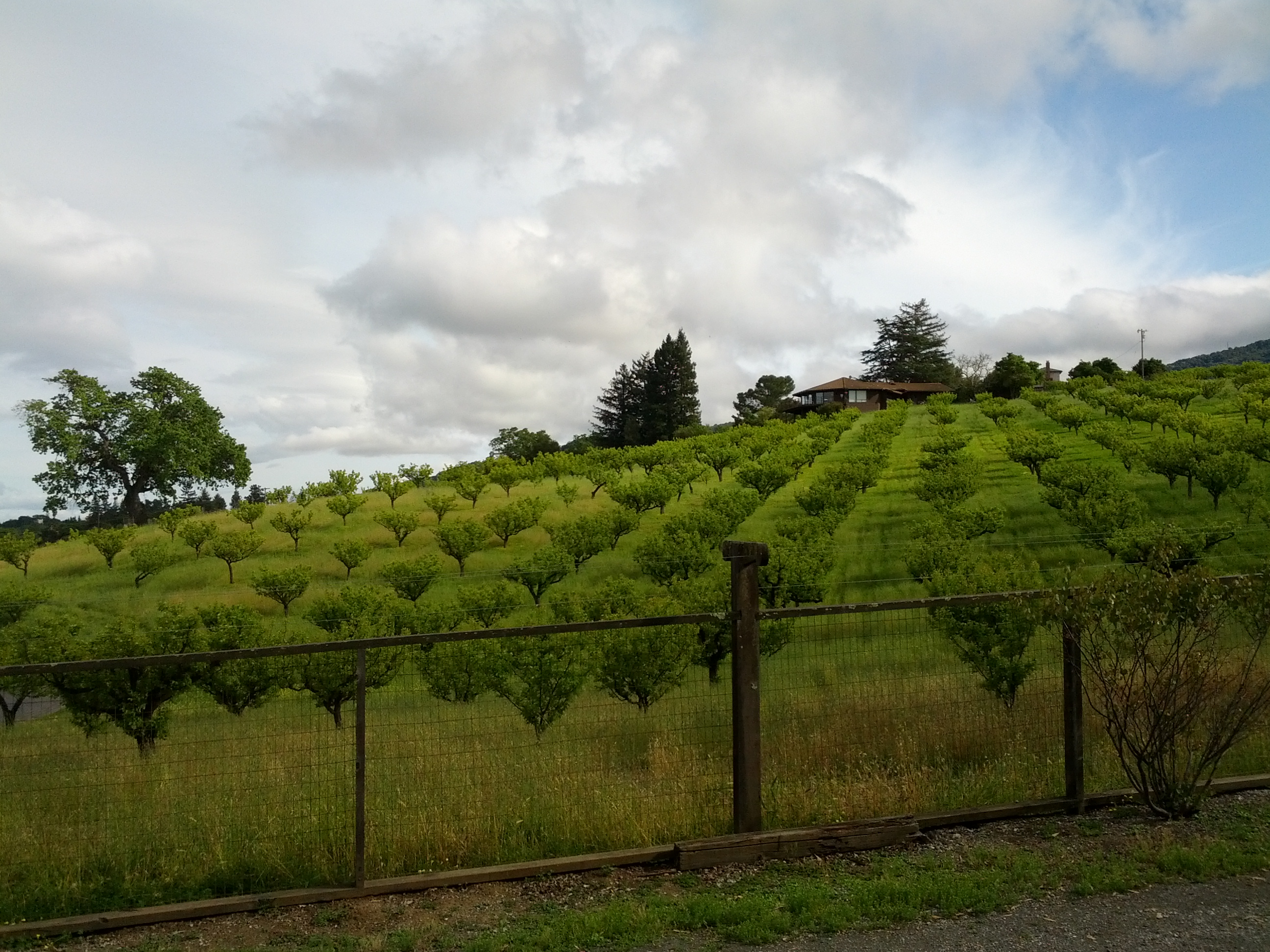
You might remember the challenge to identify an image of a low hillside of trees.  

That was the search challenge from April 24th, 2013.  

Remember this image?  The questions were "what kind of trees are these?" and "why did I hear a bell ringing in the afternoon?" 


I happened to ride my bike past here earlier this week (June 16).  And this image pretty well provides ground truth for us.  You can see the apricots in the trees and all over the ground from windfalls.  


We don't always get ground truth in our business.  But sometimes, just sometimes, we do.  It's good to double check these things.  

(And now, because I'm a curious kind of guy, I look at this picture and wonder why there are NO weeds or grass here.  What's up with that?  I'm sure they disced the soil around the trees... but that's impressively weed-free.  Or are they using some kind of grass-specific herbicide?  Maybe an upcoming challenge?) 


Monday, June 17, 2013

Newspaper Archives--Google's archive... and beyond

Searching through newspaper archives is a bit like emerald mining--you can get rich, if only you know where the gems are hidden.  

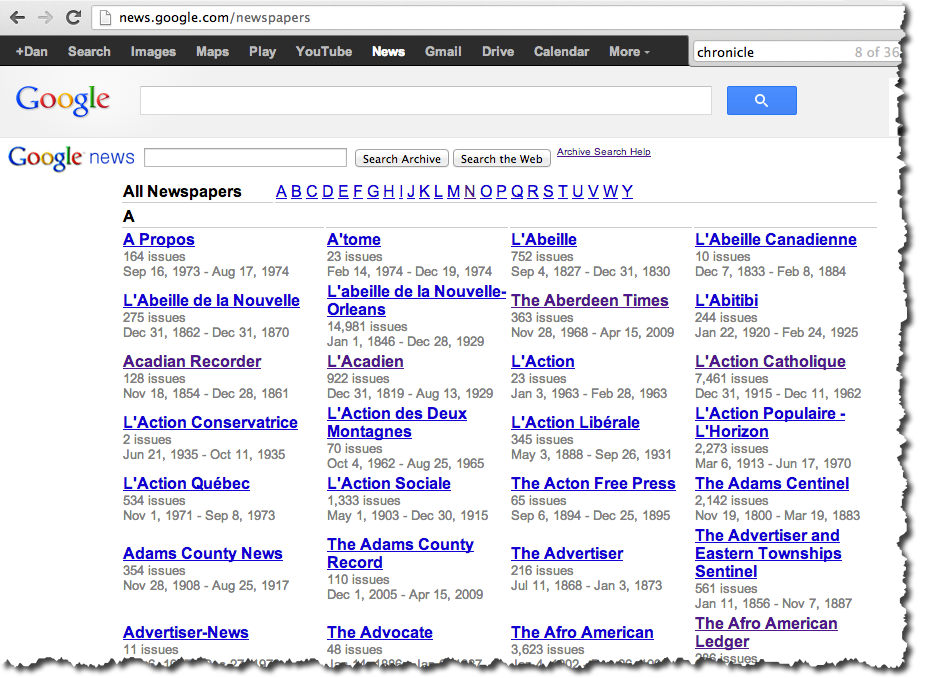
Some recent changes have made Google's newspaper archive a bit more hidden than it should be.  So I wanted to let you know how to find the (still up and running!) Google newspaper archives.  Sure, you can search for it, but the best result is a bit hidden, so let me give it you up front and easily accessible. 

http://news.google.com/newspapers 

This is the link you want to bookmark or remember.  


As you can see, there are a LOT of papers in this collection. (2,463 different papers by my count.)  Note that the collection is very spotty.  It may contain the entire run of all issues of an important paper, or it might have just one or two pages from a hundred-year run of another. 

Thing is, NO single collection is complete.  You still, as a search-researcher, will have to sift through multiple newspaper collections as you do your searches.  

The next best resource I know (and use!) is the Wikipedia master list of newspaper archives.  


As they helpfully point out, some local public libraries subscribe to some online newspaper archives that you can use... often limited to their physical location.  In many cases, your access may be restricted to searching the archives when in the building itself (such an odd 20th century notion), or in some cases to library card holders through their portal.  


The Wikipedia list notes which are free, and when known, what the size and scope of the collection is. Note in particular that they list a great deal of international resources (the majority of the Google collection is North American-centric).  

Remember that most newspaper archive collections are OCRd from the original scans, and as a consequence are full of inevitable errors.  There are many time you just need to go look at an article.  Unlike many databases, OCRd texts from newspapers is just an unreliable transcription.  Go look for yourself.  

And enjoy.  These collections make for fascinating reading.  

Which newspaper collections do YOU like the most? 


Search on! 


Thursday, June 13, 2013

Answer: Who came up with this big idea?

So.

This blogpost is a little like life.

What started as a subtle error has turned into a teaching moment!

The error I made in the original question was to ask: 
1.  His poetry tells us that life is just a little of the good and of the bad, but he dreamed big and is credited with the idea of creating a well-known national landmark.  What is his name? 
But as several readers noticed—the quote was actually written by someone else, who did NOT create a nationally known landmark, but was merely associated with the person we’re really looking seeking by being quoted in an article by the person we seek.  

Teachable moment:  This kind of error happens all the time in real search tasks.  An incredibly valuable thing to know is how to overcome this kind of error. 

I’m not sure if this kind of error has a given name or not (if you know of one—let me know!), but for our purposes, let’s call it the problem statement error (shorthand:  PSE). 

PSEs happens all the time at library reference desks.  A patron will come up to the desk and ask a reasonable sounding question:  “Where can I find the novel ‘War & Peaches’?”  Good question, but you know they’re looking for ‘War & Peace.’  That’s a PSE. 

Or that old canard, "How many pairs of animals did Moses take with him into the ark?"  Correct answer?  None.  Moses didn't go in the ark...

More seriously, someone will want to know when Hemingway wrote that article about a “crap detector” in Harper’s Magazine.  Again, a good question, but the article in question was never published in Harper’s—it was the Atlantic Magazine (August, 1965).  

Again, that’s a PSE.  It's often a small mistake in the attribution that will send the searcher down the wrong path.  

A PSE is a problem that has a twist in it, a little like a mystery, that you, the researcher, has to untwist in order to solve. 

In OUR case, if you search for:

["life is just a little of the good and of the bad"]

You can find it referred to in a few places.  Perhaps the simplest is in the USGenWeb archives site.  http://files.usgwarchives.net/sd/biography/coursey/robinson.txt  

This is a text about a man by the name of Doane Robinson from the Book " Who's who in South Dakota"  by O. W. Coursey (1913).  

Follow that up with the obvious search:  

 [doane robinson]

Leads you to the Wikipedia article about Doane Robinson, along with other articles, such as the PBS story about Robinson and several others.  

You quickly learn that Robinson was the man who came up with the original idea for Mt. Rushmore.  He got the ball rolling on creating this giant set of statues in South Dakota.  

Quick answers: 

1. The quoted poetry, “life is just a little of the good and of the bad” isn’t actually by Doane Robinson, but HE is the man who dreamed big and receives the credit for coming up with the idea of creating a monumental sculpture in South Dakota.  His name?  Doane Robinson.

2. Once you've figured out who had this big idea, the landmark we see today is not what he originally envisioned. What was his original plan for the national landmark?  A:  In 1923, Doane Robinson wanted the faces of George Armstrong Custer, Buffalo Bill Cody, Lewis and Clark, and Sioux warriors. His original idea was to carve them in a region called the Needles, but Gustav Borglum, the sculptor, decided they were too thin and difficult to carve.  They moved the project to Mount Rushmore. 


HOWEVER..

…as several sharp-eyed readers pointed out, that fragment of a poem is ACTUALLY by someone else.

In the text above, the poem is credited to Frank W. Taylor, Jr.  (1909)   See http://newspaperarchive.com/oelwein-daily-register/1909-05-12  

The front page contains a poem titled "Dipped from the Stream" authored by Frank W. Taylor Jr. The last lines of the poem are "That life is just a little/Of the good and of the bad.” 

That’s the poem quoted in the article about Doane Robinson.  And that’s the source of the PSE.  Robinson didn’t write the poem, but it was quoted in the article about him.  

Regular reader PASSAGE complained, “Not Fair!”  And I understand… a little. 

But this is the way real research works, and this kind of thing happens ALL the time at library reference desks.  It’s often the result of following along on strange pathways to get where you need to go. 


Search lessons:  There are actually several here.  

A.  Use double quotes when searching for a sequence of common words.  (Example:  "life is just a little of the good and of the bad" -- all common words made interesting only by their sequence.)  

B.  Read the surrounding context carefully!  I misread the appearance of the quotation as being written by Robinson.  Not so!  The article about Robinson merely quotes Taylor's original poem.  

C.  Be ever suspicious about the problem that are given to you.  Often they are more subtle (and involved) than you might expect.  Beware the Problem Statement Error!! 


And so, as ever... we go... 

Searching on! 


(If you know a better phrase that "Problem Statement Error," let me know!)  


Wednesday, June 12, 2013

Wednesday search challenge (6/12/13): Who came up with this big idea?


Today's search challenge is a great example of a couple of skills--great for teaching students how/when/when to use advanced operators.  

This is from regular reader Tasha.  (Thanks!)  

Challenge:  


1.  His poetry tells us that life is just a little of the good and of the bad, but he dreamed big and is credited with the idea of creating a well-known national landmark.  What is his name?     
2.  Once you've figured out who had this big idea, the landmark we see today is not what he originally envisioned.  What was his original plan for the national landmark? 

As usual, be sure to tell us both how long you took to find the answer, and what you did in order to find the answers? 

Search on! 


Friday, June 7, 2013

Be prepared: What will happen to your content when you die?

We don't like to think about it, but eventually we're all on a schedule to die (or at very least, become extremely incapacitated).  

If that happens before you're ready--and mostly, that's the case--what happens to all your digital stuff? Your email accounts, social media, and imagery all will become locked-up in everlasting digital limbo.  Unreachable by all, including your family. 

Recently Google announced an "Inactive Account Manager" tool.  Click on that link and you'll be taken to a setup page that will let you determine what happens when you are taken out-of-action.  

Image from Inactive Account Manager.


You can set up a "deadman switch," which triggers if you haven't done anything after a certain amount of time (say, 6 months or 1 year).  When the timeout happens, the system will email or text you to see if you're still responding.  If you're STILL not responding, it will infer that you're not taking care of your data any more and will do what you want. 

Should some of your selected contacts be notified?  It can do that.  (With whatever messages you want sent.)  

Should your accounts be deleted?  It can do that too.  

Here's the truth:  If you're alive and reading this, you probably should go fill out the form.  

I just did.  It only takes a couple of minutes to set it up.


Even though it's a sobering thought, if you don't do it, your family and friends won't be able to get into your accounts and those posts, images, and messages you always meant to send.   

Something to think about.  Here's a nice way to manage your digital afterlife.  

Thursday, June 6, 2013

Answer: Crowdsourcing discoveries...

Well.. THAT was interesting!  


To the folks who took the time to write a little something in the shared document--a big thanks from me!!  

I have to admit to being slightly surprised that more people didn't write something in the shared document.  

IF YOU DIDN'T WRITE ANYTHING... could you reply to this post and say why?  Even if it's just "too busy"--that would be useful.  

Tell me also if there IS a crowdsourcing question I could ask that would motivate you to write something.  Was the topic ("Pacific Crest Trail") just too esoteric for you?  Or was it just not-all-that-interesting?  

Thanks! 


Now... To the folks who DID write something:  Thanks again!  The things you found and how you found them were fascinating reading.  

Someone added the terminal post images to the doc.  (I can't tell who!)  

Ramon added a bunch of nice images which give you a sense for how varied the weather can be.  (Good point.) 

Hans added the discussion about the "Fastest time" to through-hike the entire trail--an amazing 83 days, 5 hours.  I hadn't thought about that. 

And the originator of the challenge, Rosemary, put her post into the comments (so I copy/pasted them into the shared doc for you, Rosemary... hope you don't mind).  


All in all, an interesting little experiment.  

I didn't quite get the numbers of participants that I was hoping for (which is why I'm hoping people will reply to this in the comments section).... I'd like to get a sense for what works and why. 

Thanks again!  

Happy trails! 

Wednesday, June 5, 2013

Wednesday Search Challenge (6/5/13): Crowdsourcing discoveries...

One of the greatest ideas of the past several years has been the concept of crowdsourcing.  That's when a bunch of people distributed all over the internet work together to take a small piece of a bigger puzzle, and by solving their small piece, they contribute to a larger, deeper, greater piece of work.  

A while back regular reader Rosemary suggested this idea for the Wednesday Search Challenge.  She wrote that she's always thought the the Pacific Crest Trail (PCT) would be wonderful to explore, but that she probably wasn't going to hike the whole distance herself.  But wouldn't it be great if all of us readers at SearchResearch could do the same thing as a group? 

While the idea of hiking the PCT with a few thousand other people is kind of wild and overwhelminmg, (imagine! a horde of hikers crowding down the trail) maybe we could crowdsource this.  

Background and Challenge:  


The Pacific Crest Trail runs 2,650 miles (4,265 kilometers) from Mexico to Canada through California, Oregon, and Washington. It crosses deserts, glaciers, the crest of the Sierra, and deep forest. 
Research question for you... 
Can you, using the searchResearch methods you know about, find interesting parts of the trail?   
Can you find use Google Earth or Maps to find unexpected views, beautiful paths, and impressive vistats?   
Can you find out something interesting about the history or geology or biology along the PCT? 
Can you locate specific threatened/protected wildlife (marine or land)?  
When you DO find something you love or enjoy--let us know about it... and how you found it.   


Feel free to use everything you've ever learned about on the web...  News/Books/Blogs/Archives... 

It's an open web kind of problem.  

Let's dive in!  

I'll write up my answer tomorrow morning with MY favorite place along the PCT and why I like it so much.  

Be sure to let us know how you found your favorite places, and give us a little story about why you find it so interesting! 

You can put your comments into our shared Google Doc:  Crowdsourced Favorites from the Pacific Crest Trail.  Click there to open the doc and add your comments.  Please follow the pattern I set up at the top.  (And no, you don't have to add your name if you don't want.) 

Search (and write!) on! 


Friday, May 31, 2013

Answer: Wednesday search challenge (5/29/13): Who owned Edgewood Park before it was a park?


The questions were: 

Can you find: 


1.  Who owned the land that would become Edgewood Park between (around) 1908 until his death in 1930?   
2.  This man was quite a character: What was his job?  And what athletic records did he hold?   
3.  What did he hold a patent for?  

4.  And, if you have the time, where is he buried?  

The quick answers: 

1.  Henry C. Finkler. 
2.  He was a clerk for the California Supreme Court. 
3.  Bicycle brakes. 
4.  Union Cemetery, Redwood City, CA.   

Now... let's talk about how to find answers to questions like this.  

As several readers noted, the first question is a little tricky.  After a few false starts (including queries like [ Edgewood Park owner ] and similar), I finally figured out that asking about the history of the place would be productive.  I discovered along the way that there are multiple Edgewood Parks (including one in CT), so I tried this query:  

   [ Edgewood Park history California ] 

quickly led me to both the park's website  (interesting, but not helpful for this search), and the "Friends of Edgewood" site (interesting AND helpful!). 

From that site, I found a couple of Acrobat files, including the Strategic Plan which has a nice section detailing Henry Finkler's acquisition of the property in 1908 from John Issac. The Taylor family acquired it after Finkler, and then the State of California acquired the land through eminent domain to build a new college campus in 1967.  Those plans fell through in 1980 and the state sold it as excess property to the county.  It is now a preserve, a place that's not quite pristine, but definitely a lovely place to visit.  

Once armed with the name "Henry C. Finkler" the rest of the questions are pretty straightforward.  (With a name that uncommon, you might expect that.)  

With just a little looking around, you can find several articles (including archival newspaper stories from the San Mateo Times of 12-17-1931) that go into his life (colorful, with claims of the ability to control the entire San Francisco water supply through secret valves on his property, tunnels that went miles into the hills, etc.)

Finkler's  father, a supreme court bailiff, committed suicide when Henry was 19, leaving Hencry C. to assume his father's position as court bailiff, eventually becoming Senior Secretary. He was obsessed with gathering weather stats, claiming that where he lived was one of only three perfect climates in the world. His weather records were used to support the prize-winning slogan, “Climate Best by Government Test,” which is still Redwood City’s official slogan.  


In his early years, he also "competed in high-wheel (pennyfarthing) bicycle riding and became the state champion in both short and long distances."

Here's an image from the FriendsOfEdgeWood site that's just charming... and gives a decent idea of the man.  

I'm trying to imagine Henry C. riding his high-wheeler across the early roads of the area at the time.  With this image in mind, it's easy to do... 

Patent:  If you go to Google Patent Search, and then just search for: 

   [ Henry C Finkler ] 

you'll find his patent (#488066, issued 12/13/1892) easily enough.  (Note that the name is mistranscribed as "Henry G. Finkler."  An obvious OCR error that's easily overcome.)  

And lastly, his gravesite?  

    [ Henry C Finkler grave ] 

You'll find he's in Redwood City, only a few miles from where his house was built very near to Finkler's bridge.  He is buried at the Union Cemetery, in a masonic plot (here's a pic of the grave, with the masonic symbol).  

The newspaper accounts are full of the lurid details of his life... tabloid stuff even now, 83 years later.  

Search on! 


Wednesday, May 29, 2013

Wednesday search challenge (5/29/13): Who owned Edgewood Park before it was a park?

One of my very favorite places to go walking or running in the springtime is Edgewood Park.  It's in Redwood City, about 25 minutes from the Googleplex.  It's a large open space that's geologically interesting because it has a good deal of serpentine soils.  (Serpentine is a kind of stone that is has low calcium-to-magnesium ratio and few essential nutrients such as nitrogen, potassium, and phosphorus.  That means it's not great for plants from other parts of the world--only native plants can grow well in serpentine soil!)

As a consequence, the place is full of wildflowers, and threaded through with trails that go from deep forest to open hillside.  In the spring, streams run down the hillside and bird song sounds throughout the whole place.  It's really wonderful.  

So, being a curious fellow, I wondered how such a large park in the heart of Silicon Valley came to be. 

I did a little research, and discovered a remarkable tale of a man who seems as though he stepped out of a storybook, which leads to today's challenge.  

Can you find: 

1.  Who owned the land that would become Edgewood Park between (around) 1908 until his death in 1930?   
2.  This man was quite a character: What was his job?  And what athletic records did he hold?   
3.  What did he hold a patent for?  
4.  And, if you have the time, where is he buried?  

As always, let us know HOW you found this information, and about how long it took you to do so.  

Search on!