.jpg) |
| John J Williams, last US Civil War casualty. A victim of slow information updates. (From Wikimedia) |
It's clear that news about the end of the war spread slowly. Even though telegraphy was widely used, there were still many places that weren't "wired" to receive the news. Those gaps in coverage cost time (at least 1 month here), and ultimately, lives.
This same thing still happens, though perhaps with lesser consequences these days.
In my earlier post about the Capitoline Wolf, several people asked "So what did your daughter put on her test?"
I finally got the answer: She put down that it was of Etruscan origin, even though she knows it's not.
"Why did you put down something you know is wrong?" I asked. "Because I need the point on the test..." was her reply.
That's a pragmatic answer, and I can't give her a hard time for wanting to do well on the test.
Naturally, I think I would have objected and fought for the point.
This is personally important because a similar thing happened to me when I was a high school sophomore, and it pretty directly led to my career as a research scientist.
In my high school biology class, my teacher kept talking about the various causes of diseases--"there are millions of diseases caused by bacteria and viruses... and thousands of diseases caused by protozoa..."
I heard that and thought about all the diseases I could think of that were protozoan-caused. I thought of malaria, elephantiasis, sleeping sickness... and I couldn't think of any more. "Thousands?" Really?
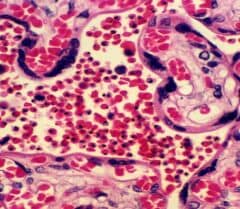 |
| Malaria infected cells. (From CDC.gov) |
I did. And discovered a few more diseases that I hadn't known about. But that took the number up to 12, not thousands.
But it was that inspirational moment for a kid in school, and I worked for a few weeks on the question, visiting libraries, and ultimately writing to the head of the Microbiology department at UCLA.
Graciously, and to my everlasting debt, a faculty member wrote back to me with a few photocopied pages from a textbook (I believe it was Human Parasitology), with a kind note saying that I was correct, there aren't that many protozoan-caused diseases. Here's the list: there are (at the time) around 20.
That was a pivotal moment for me: I developed a life-long habit of probing deeply into the whys and hows of assumed information.
Of course, since my time in high school (in the 1970s!), it's become much simpler to do this kind of questioning of received knowledge.
It's a habit I think we ALL need to take on--in both our roles as students (because we're all permanent students now), and as teachers (because we're also all teachers now).
Which takes me back to the Capitoline Wolf problem. It's been known for a long time that the Capitoline Wolf isn't of Etruscan origin--but the books haven't been updated to reflect that.
I would think that responsible teachers would WANT to be as up-to-date as possible, and maintain an errata or updates file on all of the materials they're using. It's a pity that textbook publishers don't do this. (Or if they do, I want to know about it!)
There's a long list of things we used to teach that are no longer considered to be true. Junk DNA is no longer "junk," Pluto is no longer a major planet, but now a "minor planet," the largest known prime number (currently 257885161-1, but certain to change soon), etc.
I'm not expecting the textbook publishers to step up here, so it's really all of our jobs.
Although it might be really useful to create a socially-generated site that updates "facts that have changed in your field" wiki. Anyone up for the challenge?
And most of all I would love it if teachers would be actively modeling this for their students. Kids shouldn't have to give the "expected answer" when they know it's wrong. They should get extra credit for discovering an update to the course.
I got an extra point in my biology class in the '70s for fixing a misconception on the part of my biology teacher. (But I wonder if he fixed it in the class materials for the next year...)
And then we could feed this back into the publishers and help keep our students' materials up-to-date.
Just a thought.
What would you do? What knowledge do we teach that's woefully out of date?
Search on!


