Friday, February 7, 2014

Answer: What's that wreck in the water?

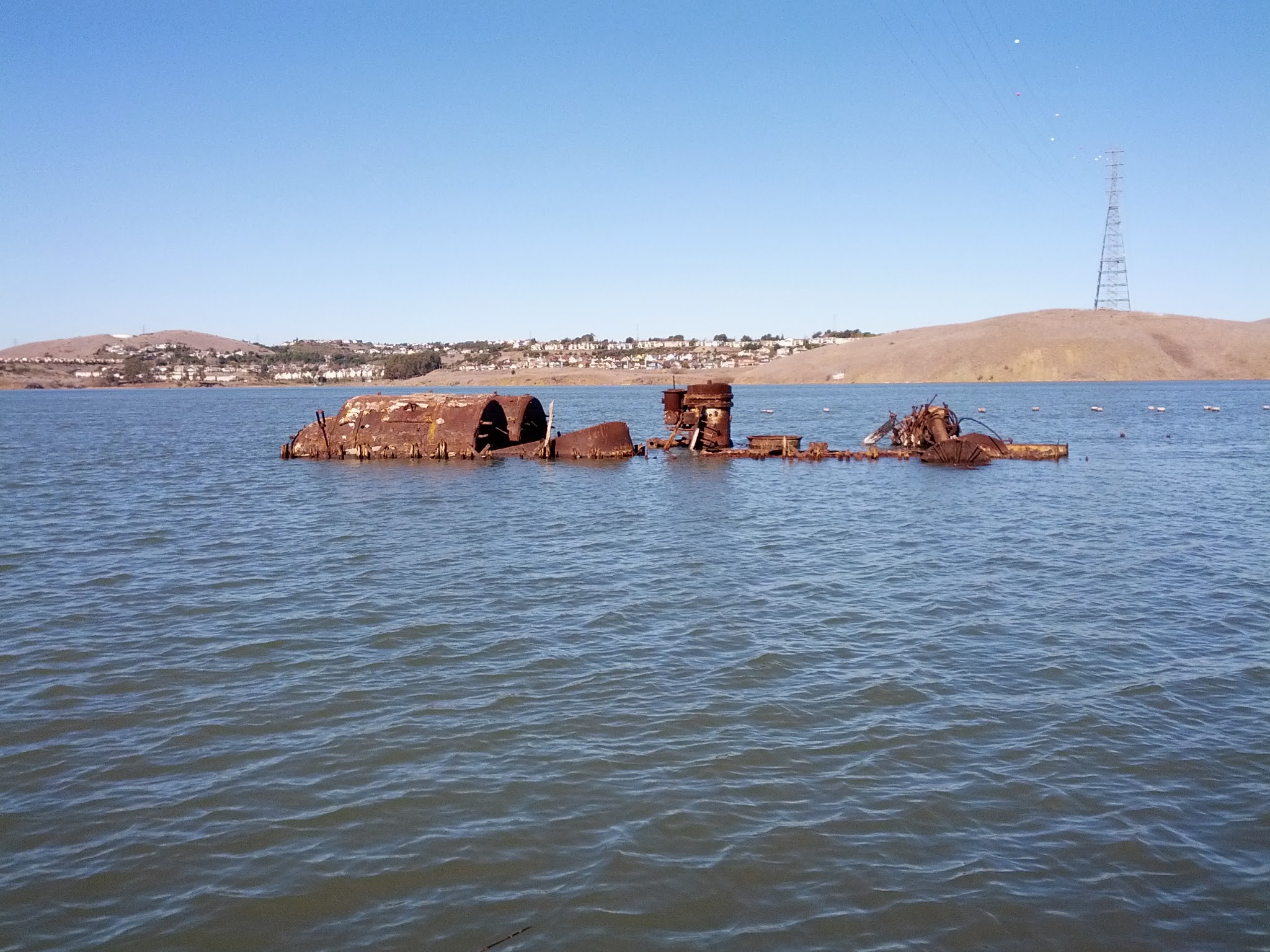
This week's Search Challenge was to figure out the story of this hunk of junk lying in the water of the Carquinez Straits.  (It's also worth looking at Remmij's "reverse angle" shot of the wreckage by Jafafa Hots.)


Specifically: 


1.  What's the story of this wreck?  (What was it?  Did it have a name?  Why is it here?)  
2.  Can you find a picture of it (whatever it was) taken BEFORE it turned into a ruin?    
3.  Can you find a newspaper article about how this wreck came to be?   (Extra credit)   

Here's what I did.

1.  What's the story of this wreck?  (What was it?  Did it have a name?  Why is it here?)  
First, I knew it was a cell-phone photo, so I just extracted the EXIF data from the photo (I used Fileviewer, but there are many approaches--I'll write up a quick summary next week about how to get the EXIF data).  We know the lat/long information is there, so I pulled it out using FileViewer.  (38.054242,-122.20228)  
I started by going to Google Maps to get a look-around, just to see what things might be nearby that I could use as search terms.  Here's what I saw when I put the lat/long into Maps. 

But that's a little too far out to be useful.  I thought I should zoom in a bit to see more detail.  


And... what do you know?  There's the answer right there on the map!  At exactly the place where my "hunk of junk" lay, the map as "Garden City Wreckage" marked. 
Longtime Maps users know that there are layers of information that show up at different zoom levels.  Unfortunately, you can't turn them on/off individually, but have to manually zoom in-and-out until the layer you want appears.  In this case, I got lucky that it had shown up.  (If it hadn't, I would have used other clues shown here--such as "Eckley Pier," "Bull Valley," or the nearby town of "Port Costa" as place names.  I'd have found it that way.) 
But, as often happens, someone else had already marked this particular spectacular junk pile.  I switched to Earth view and zoomed way in to see if it was what I thought it was.  Here's the Earth image (and it's clearly the same, although at low tide).  

Now that I know it's the "Garden City" (and probably a boat of some kind), I had to figure out the story.  
A query for: 
     [ "Garden City" wreckage ]  
returns a large number of hits, all of which tell the story of how the Garden City was built in 1879 as a sidewheel ferry for the South Pacific Coast Railroad to move train cars to San Francisco.  
Although the Garden City was built with narrow-gauge track on the main deck to carry freight cars to San Francisco, but could also carry passengers and cars as a relief ferry. Southern Pacific used Garden City as a relief boat for their auto ferry run on the old "creek route". Garden City stayed on the "creek route" as a passenger ferry when auto ferry service was shifted to the Oakland pier. 
The ferry ran from Alameda to San Francisco until 1929 when it was brought to the piers at the town of Eckley as a fishing resort. Unfortunately, that was its last assignment before becoming a picturesque wreck. 

2.  Can you find a picture of it (whatever it was) taken BEFORE it turned into a ruin?
This task wasn't that hard:  
     [ "Garden City" ferry ] 
If you search in Images, there are quite a few images out there.  Here's a link to one from Dory Adams' web site showing the ferry before it became a wreck.  
Garden City Ferry, 1980.  Linked image from Dory Adams site, taken by Kevin Scanlon.

And another image of the Garden City steaming into the Ferry Building at the Embarcadero in San Francisco (c. 1904).  


From the Wikimapia site I first got the clue that the wreckage was there because the docked ferry had burned at some time in the 1980s.  That led to my next query: 
     [ "Garden City" ferry burn ] 
With this query I found the PrivateNaturalist web site (which tells his own story of searching for the Garden City), and tells me that “This rusting heap is the boilers and paddle-wheel hub of the old Southern Pacific Ferry Boat “Garden City”… it burned to the waterline in the fire of 1983.”
Another clue. Fire! 

3.  Can you find a newspaper article about how this wreck came to be?  Now it's time to turn to my trusty Newspaper Archives.  So I visit News.Google.com/newspapers and redo my query there.  This leads to several articles in the news archives, all saying more or less the same thing.  Fires, started by arsonists, destroyed large parts of the area, and spread onto the old wooden ferry, burning it to the waterline next to the Eckley pier on Sunday, August 7, 1983.  
Because I was curious, I also check Google Books for any mention of the Garden City ferry, and found a few.   It was a quick click to find Ferries of San Francisco Bay by Paul C. Trimble.  (Note that you search in this book for "Garden Ferry." There are 4 great photos on pages 27 and 28.)  
Another excellent book is Port Costa which also tells the history of "Garden City" with many images over the years, and with a detail saying that it was the "largest dance floor in Contra Costa county" in its day.  There's also a Christmas card from its time as fishing resort. 

But as I mentioned in yesterday's post, there are also often county-wide historical societies that collect information (and photos).  I thought I'd look for the county that might have information.  Since Port Costa is the closest town of any size (and it's pretty small), I did the obvious query: 
     [ what county is Port Costa in ] 


Note that this gives us a name and a map.  Now that I know the county name, I can look for: 

 
   [Contra Costa historical society]

and find The Contra Costa Historical Society .  Their site is a little funky, but by navigating down (search doesn't seem to work very well), I was able to find all of the photos shown in the previous pages, and get confirmation from a different (and very local source).  
As another approach, I could have looked in Google Maps for: 

     [ Contra Costa libraries ] 

or, using Maps, zoomed into the place of interest, and search for [ library ] 


Search Lessons: 

1.  Zooming in on a map can sometimes reveal information you can't see at all levels.  In this case, it basically gave me the answer instantly, but you have to know to zoom all the way in (and check each level--most easily done by using the + and - controls).  

2.  Switching the view to Earth can also reveal new information.  In this case, we can see that the wreckage is accessible at low tide.  (I'm tempted to go back!)  

3.  Using local place names can help focus the search and find new information.  In this case, Eckley is name of the pier, but it WAS the name of the village where the Garden City was finally moored.  Likewise, Port Costa is the closest "big" town (nowadays, it's around 200 people), but it's a longer lasting place that Eckley, which no longer has any town left.  BOTH place names, though, help to find news articles and books with local information.  

4.  Local historical societies and libraries often have great local historical information.  Here, I used the "look for a county historical society" trick to locate a nearby cache of historical photos.  Keep that in mind when you're searching for this kind of information.  


Finally, I have to include Rosemary's story from the comments (I'm adding it here because it was an aspect of the story that I hadn't thought about.  And it turns out to be intriguing...)   


The arsonist aspect of the 1983 fire was of interest to me so I searched papers to see if the person was caught. The Rodeo fire chief's son was responsible and pleaded guilty. He was sent for psychological testing. His father was to retire the next month. (News article) 

Here's an article that indicates his father turned in his son for the crime after admitting he was responsible.  That's a difficult thing for any father to admit, perhaps especially one who is the local fire chief.  


Thursday, February 6, 2014

More on that wreck in the Carquinez Straits

Excellent work, Researchers!  

But there's more. 

There's another source of information that I don't think anyone has considered yet.  

As wonderful as the newspaper articles are, and as rich as books on the area are, and as fantastic as the local maps are... there is another source for this kind of information.   

Unfortunately, sources almost never rise to the top in an ordinary search, so you have to know about it, and then go looking for them as well. 

Consider looking for local libraries, historical societies, and museums.  (Remember? We talked about the role of libraries and museums in an earlier Search Challenge.)  

The old library in Boulder, CO, home to the local historical archives.

They often collect locally relevant historical information (maps, photos, oral histories), making at least some of their collection available online. 

And even if they don't have a great deal online, they frequently will point to other relevant nearby collections that do.  

As several people have pointed out, this wreck is near the former town of Eckley (so there's no library to find), so you'll have to expand your search to include other nearby towns.  

Pro tip:  In the US (and, I believe in the UK), historical organizations are also sometimes set up at the county level. Search for organizations along those lines, and see what you can find.  

Keep searching!  There's always more to the story... 


Also, to keep the narrative together, please don't comment HERE on this post about the search challenge.  If you have a comment about the search challenge, go back to the previous post (see "Older post" link below), and leave your comment there.  K? 


Wednesday, February 5, 2014

Wednesday Search Challenge (2/5/14): What wreck is this?

Last Saturday I went for a run in the North Bay along the shoreline.  Along the way I ran past a big pile of iron and steel sticking up out of the water in the strait.  


Being a curious sort of fellow, I took a picture with my phone and kept going on my run, knowing that later I could figure out what it was all about.  

Sure enough, I was able to figure this out without difficulty.  Can you?  

Today's questions are: 


1.  What's the story of this wreck?  (What was it?  Did it have a name?  Why is it here?)  
2.  Can you find a picture of it (whatever it was) taken BEFORE it turned into a ruin?   
3.  Can you find a newspaper article about how this wreck came to be?   (Extra credit)   

When you post your answer in the comment stream, be sure to tell us HOW you found the answer. What queries did you do?  What search terms worked? (And which did NOT work?)  

Tell us about your search process, so we all can learn. 


Search on!  

Friday, January 31, 2014

Answer: Can I recycle a milk carton in Palo Alto, CA?

Remember that this week's search challenge was about as simple as they come.  I sent out a survey and asked if... 


Wednesday, January 29, 2014

Wednesday Search Challenge (1/29/14): Can I recycle a milk carton in Palo Alto, CA?

Today's search challenge shouldn't take long.  In fact, today's challenge is to find the answer and fill out the form in just a few minutes.

Background:  As you know, every so often I do small tests to see how well people can search for this-or-that.  This is one of my classic questions that I use for calibration purposes.  I'll explain why on Friday (and share the results with you).  

In the meantime, if you want to add a comment below, that would be great.  

Let us know how it went for you! 

Search on! 

Tuesday, January 28, 2014

Essay on literacy: What should writers expect from readers?

Thoughts about what it means to be a writer & a reader now.... 


What do I expect from you, dear reader?  More importantly, what does any author expect of their readers?  

Do I expect that you’ll skim over the text and smile quietly, or do I expect you to wrestle and engage with it, mano-a-mano? 

Suppose I use a word like “vasty.”  What do you think as your eye passes over?  Perhaps I would have used it in a sentence like “This essay is a place of vasty ideas.
  
As you read, you might have had a momentary mild surprise, but then keep on reading.  Since you know me and have read things like this before, you’d probably assume that it's not a typo, and I had something slightly odd in mind.  But unless you’re a dedicated reader and burdened with an endlessly inquiring mind, you probably won't look it up. 

Why not?  In an online world, where many things are quickly searchable, why not?  What does this say about the nature of reading?  


These are the kinds of questions every writer constantly asks as they write:  “Is this getting my point across?   Will people understand what I mean if I use this word?  What about that word?  Should I use concept A or concept B to be as clear as possible?” 

I’m not sure how other writers do this, but we are always standing balanced on the knife edge of decision.  Shift the salami of choice one way, and the edge cuts fine and the word works in the text; shift it the other, and the wounded word drops to the floor, un-understood and point missed.  This is true at the microscopic level (word by word, slice-by-slice), and at the macroscopic level (story thread by story thread, or salami-by-salami). 

One of the joys of reading is seeing the way some writers play with language.  I completely enjoy reading books by Barry Lopez, almost always learning something new about the world, and about language at the same time.  In his essay “Effleurage: The Stroke of Fire” you learn a new word right off the bat: Effleurage is a massage done with a circular stroking movement.  What’s fascinating about this use of the word is that he’s describing the way a traditional potter’s use of a long, “dragon-shaped” wood-burning kiln to fire his pots.  That’s about as far away from the ordinary meaning of effleurage as you can get which normally has a connotation of delicacy.  But once you know that word, the essay sparks with a kind of brilliant glimmer of insight.  The potter IS massaging the kiln’s fire, moving it up and back and around in the dragon’s belly; the idea is similar, but logically distant, and very, very precise. 


Obviously, the best choice is to be self-defining in your prose choices.  Tom Robbins writes in “Still Life With Woodpecker”   that “…Hawaiian was a language that could name a fish"humuhumunukunukuapua'a" and a bird "o-o" and never mind that the bird was larger than the fish.


By the time you visually zipline over the 22 characters of the Hawaiian name, you know that humuhumunukunukuapua'a is a fish and the 3 character o’o is a bird, all nicely self-contained.  


As a writer, you expect certain things from your readers.  If you’re writing a Russian novel, readers expect interesting Slavic names.  If you’re crafting technical documentation, you write with the expectation that the reader wants to get through your sterling prose as quickly and painlessly as possible.  Naturally, the most important thing you can have in mind while writing is an image of what your readers understand and what they’ll do in response to what you write. 

It boils done to choices like this:  Can I use a word like effleurage?  Will readers understand what I mean?  Will they bother to go look it up?  What about words like quark, reification, dendrochronology, or metasequoia?  What about concepts such as Stirling engine, dark energy, or the Hanseatic League? 


I really don’t know what other writers do, but here’s what I think about as I write: 


          It’s magazines all the way down. 


What I mean is that if you’re a “Gourmet” magazine type reader, I can use vocabulary like emulsify, lecithin, and molecular gastronomy with impunity.  If you’re a “National Geographic” reader, I know I’m safe with places like Tierra del Fuego, and Alice Springs, or concepts like “walking a transect” or “karst topography.”  A “Reader’s Digest” reader implies a certain level of simplicity in writing, while “National Review” implies another.  Even conceptual fields that are far flung can be useful to think about.  Someone who scans “Cigar Aficionado” will know that sometimes a Cohiba is just a Cohiba, while a “Scientific American” readers will probably understand the difference between “dark matter” and “dark energy” and if they don’t they’ll look it up.  But they also might not know the difference between Bob Marley and Bob Crachit, or care. 

So the REAL question is not just what kind of magazine audience do you write for, but also what do you expect the reading audience to do with what you write? 

Will they look up a concept or word and reach for the deeper meanings?   Will they bother to check out the reference I’ve made to an essay or book?   


I’ve found that my reading style has shifted as I move into more electronic forms.  Now, every time I see a word I don’t know, if I’m on a tablet, I long-press it to get the definition.  This has changed the way I read; it has changed the level of understanding I have.  I do more-or-less the same thing when reading an essay on my laptop.  The mention of the name of an interesting essay (say, “Effleurage: The Stroke of Fire”) causes me to copy/paste it into Google and see from whence it came.  Note that I gave you the link in the mention above.  Should I do that, or should I expect that you can do it on your own?  


Another example:  I, the writer, expect you to be able to recognize quotes.  And I guess I expect you to look up stuff that doesn’t make sense.  I expect you can find a reference even if I just sort of graze up against the idea or borrow a bit of language. 

Does this cause me to write differently?  It certainly does.  I have more expectations of you because you, gentle reader, are a creature of the present, and reading now is different than it was 50 years ago.  I expect more of my readers. 

By the way, have you looked up “vasty” yet


Turns out that it just means “vast,” after all.  BUT… it evokes a particular sense of time and place and kind of purposefully overwritten meaning.  “Vasty” was introduced in 1596 by Shakespeare in Henry IV, Part 1, so it’s been around for a while. It appears when Hotspur mocks Glendower for his outrageous claims that he can control the devil and spirits.

Glendower:  I can call spirits from the vasty deep.
Hotspur: Why, so can I, or so can any man;
              But will they come when you do call for them?
Glendower: Why, I can teach you, cousin, to command the devil
Hotspur: And I can teach thee, coz, to shame the devil—
              By telling the truth. Tell truth and shame the devil.
 Henry IV, Part I Act 3, scene 1, 52–58


That’s it—the original coinage of the term.  But you knew that.  I know some fraction of you looked it up.  

Other writers have picked up the word and used it in their own writings, but always in a passing homage to Shakespeare.  And that’s how I’m using it, as a bit of spice to the story.  And for people who remember where “vasty” comes from, it adds a twist of zest, a kind of seasoning for the mind.  In this case, I’m using it as a foil, but a fun foil that makes my point.  It’s all just words, but this one is very New Yorker and Paris Review. 

As are you—which is what I would have expected. 

Have you looked up humuhumunukunukuapua'a yet?  It’s well worth the cut-and-paste.  Such a long word, but such a brilliant fish.  

How National Geographic of you!

And how our expectations about literate reading have shifted.  


Keep reading.  But read differently.  


Monday, January 27, 2014

California droughts in the news...

I swear I didn't know this was going to happen.  

But in yesterday's (1/26/14) San Jose Mercury News, the front page article was all about Megadroughts.  The article, California drought: Past dry periods have lasted more than 200 years, scientists say (Paul Rogers, staff writer for the Mercury) echoes almost exactly what we found in our SearchResearch challenge.  

Interestingly, they show a slightly different version of the drought chart we found.  

Here, I've linked to their chart, which is based on work by E. R. Cook, et al., in Earth-Science Reviews. 


That article is: 
Cook, Edward R., et al. "North American drought: reconstructions, causes, and consequences." Earth-Science Reviews 81.1 (2007): 93-134.

and the chart above is based on Cook's Figure 10 (which is really about all of the west, including everything from east Texas up to Montana and west to the Pacific).  (Link to the PDF, if you want to read more.) 

Keep searching....