A blog about search, search skills, teaching search, learning how to search, learning how to use Google effectively, learning how to do research. It also covers a good deal of sensemaking and information foraging.
As you know, I often ask questions... ... about the world, about things I notice, about interesting places, people, and events that folks point out to me. I thought I'd try to pull together some of these observational questions into a new series on SearchResearch called "What's the story?" Each "What's the Story?" Challenge will be an open-ended question that asks you, the SearchResearcher, to figure out what's going on in the image. As I've written SRS over the years, I've discovered that almost everything is fascinating if you just dig a little bit into what's going on under the surface. The Challenge this week is the first in the What's the Story? series. See if you can't figure out, what's the story behind these images. Recently, while walking on the beach near the Southern California town of Goleta (just north of Santa Barbara) I came across two different pieces of steel that were sticking up out of the sand. They're about 100 meters apart, both buried vertically in the beach sand. This struck me as odd--this was in an ecological preserve, after all--so what are they doing there? What's the story ... behind these two pieces of steel sticking up out of the beach sand?
The Challenge is not just to figure out what these are ("Hey Dan, these are big pieces of steel stuck in the sand!"), but to dig into the backstory. How did they get there? If you're like me, you can spend many happy hours doing background research to understand the story behind the image. But the perfect answer is to find how something truly interesting about the backstory, tell us what you've found (and, as always how you found it). I spent about 2 hours doing my research on this Challenge. You don't have to spend nearly as long.. unless you get really interested. It was a huge surprise to me. Next week I'll let you know what I found, and how I found it. Search on!
I admit it: Music completely absorbs me... ... taking up most of my cognitive capacity. That's why I can't listen to music as I work--my brain can't NOT pay close attention. When I went to see the Gipsy Kings in a concert I was enchanted and fully engaged--although that didn't stop me from taking note of a few items that sparked my curiosity. As I assume you do, I always have a piece of paper and a pen to jot down these questions that I don't want to answer then and there, but things to look-up when I get home. If you look at my notes, you'll see them full of funny markings--the "look up" code (L/U) appears like this: O - L/U what language is Wil Wajiwi ? At least that's what I wrote down during the concert. It's a great way to remember all of those things you'd like to learn, but can't seem to remember when you get home.
Gipsy Kings in concert (Mountain Winery, August, 2018)
Remember that the lyrics of that song include the very mysterious passage: Wil Majiwi Wilana wil Majiwi wilmajai I understand enough Spanish to know that this ain't Spanish. So... 1. What language IS this lyric (Wil Majiwi...)? I thought that this might be tricky, so I started with a simple query: [ "majiwi" ] That is, I double-quoted it so Google wouldn't try to spell-correct it or give any synonyms. This trick is an important one to use when searching for unusual spellings or words in languages you don't know. But while this query gave me lots of lyrics (e.g., the full lyrics of the song), I didn't learn much about the language per se. I was hoping to find a commentary about the song that might say what the language was, or perhaps find that it was a place name. Neither tactic worked. Although I did find that some sources show the lyrics as:
Wil majiwi wilnana Wil machiwi wilmaqay
while some have last word as "wilnana." My next attempt was: [ define "majiwi" ] This gave me a bunch of results, many of which I opened as separate tabs ("lateral browsing"), opening 4 or 5 results at a time to quickly scan between them. I found one clue that "Majiwi" refers to an Australian Aboriginal tribe (as noted in the book An Ethnography of Stress: The Social Determinants of Health in Aboriginal Australiabut that's probably not what I was seeking. On the other hand, I DID discover that a musician by the name of Titi Robin played both the bouzouk and the oud on the track. The bouzouk (also spelled buzuq) and the oud are common in Middle Eastern / Turkish music. They're added to the mix to give the tune that particular kind of sound. This might be a hint. (As Regular Reader Luís Miguel Viterbo points out,".. it might be a Maghreb dialect of Arabic." Perhaps.) While I got a lot of results, none of them really answered my question. What to do next? I also tried to find an online language identification tool [ language identification tool ], but that didn't work out. The only one I could find online (LangScape) identified this text as Kekchi, an indigenous Mayan language of Belize. Could be; but I bet not. I don't think the Gipsy Kings have any Mayan in their background, nor have they visited Belize. However, like Remmij, I also noticed the "People also ask" box as I was doing my searching:
Clicking on the FAQ link takes you to the GipsyKings.netsite where they say the Kings sing in Gitane, a combination of Spanish, French, and Catalan. That would seem to answer the question. But Luís Miguel's comment made me think that maybe there's something else going on here. JUST TO CHECK... I did a site: search on the GipsyKings.net site to look for other mentions of language: [ site:gipsykings.net language ] that gave me 27 hits--not too many. I started checking them out and found this intriguing comment in one of the forums: "And all bets are off when they're singing in what I assume to be Caló..." What's Caló? A quick check on Wikipedia tells me that it's is a language spoken by the Spanish and Portuguese Romani. It is a mixed language based on Romance grammar, often used as an argot, a secret language for discreet communication amongst Iberian Romani. Again, from the GipsyKings.net site--a link to a Vancouver Sun newspaper article that tells us "The Kings speak and sing in the French Provencal and northern Spanish Catalan dialects in addition to the gypsies' own Romany language..." So... we don't have definitive proof, but it's clearly NOT Spanish or Portugese, but is most likely to be Gitane, Caló, or Romany...or some blend of all three.In any case, the words spoken / sung / written in the lyrics are something not in common parlance. There are still some mysteries in the world. 2. As I was sitting in the concert, I was struck by the number of times they would sing in long, beautiful, intricate phrases, spending quite a while varying a single note up and down. It occurred to me that this musical technique MUST have a name. I'd like to know more about this practice, but to search for it, I need to know what to search for--so... what's this called? I liked Remmij's search--the query: [ what is it called singing a single note in a variety of ways ] gives a nice answer:
My query was a variation on this search: [ singing many pitches on a single syllable ] which gets you to the idea of melisma.
1. Not everything has a simple answer! It turns out that my simple note to myself ("what language is...") isn't easily answerable. At least not yet! At some point, some journalist might well ask this question, and we'll get the answer from the source. But at the moment... it's still a mystery. 2. Take notes and remember to look things up later. I didn't want to look up the language while attending the concert. (I wouldn't be that rude!) But I did want to remember to check. While it's a simple thing, looking up things that you've noticed throughout the day (or the concert) enriches your understanding of the world. Take notes! (And remember to check your notes when you get home.) 3. A simple description of the thing you seek often works really well. In searching for that singing style, the fastest search is a short description that contains all of the key features (in this case, multiple pitches on a single syllable). As always, search on! _________________ (book update) The Joy of Finding Out All of the copyedits got turned in on Monday of this week--exactly on schedule. I get one more iteration on copyediting, then on to the full resolution galleys! Forward progress was made!
Welcome to 2019! A new year, with new Challenges and a few new ideas. First, a quick update on the book (The Joy of Finding Out): I'm in the last couple of days of copyediting. Then it goes back to the publisher so they can prepare the galleys. (That's the full resolution printing of the book and the last possibility of an edit.) THEN... off to printing! We should get them by May or June. I'll be sure to let you know when the book can be pre-ordered! On to our Challenge for this week... Late last year I went to see the Gipsy Kings in a concert at a winery in the hills over Silicon Valley. It was a spectacular evening with brilliant music that's a blend of gypsy, flamenco, salsa, and pop--all sung in Andalusian Spanish.
Gipsy Kings in concert (Mountain Winery, August, 2018)
Mostly. They do have one song that baffles me. It's Majiwi, which has the lyrics: Wil Majiwi Wilana wil Majiwi wilmajai I understand enough Spanish to know that this ain't Spanish. So... 1. What language IS this lyric (Majiwi Majiwi...)? 2. As I was sitting in the concert, I was struck by the number of times they would sing in long, beautiful, intricate phrases, spending quite a while varying a single note up and down. It occurred to me that this musical technique MUST have a name. I'd like to know more about this practice, but to search for it, I need to know what to search for--so... what's this called? Here's a short sample of that musical effect that I include for illustrative purposes. MP3 file -- two samples of the mystery musical effect. What IS this called? As always, tell us HOW you figured this out? Is there something we can learn from your searching? (And be sure to tell us if you just knew it off the top of your head...) Have fun with this! Search on!
I made it back to Bonaire this year, looking for more parrotfish, and more Challenges. The tropics will return to SRS in the months ahead!
When I look back over the past twelve months of Challenges, answers, comments, and discussion, I see a rich back-and-forth between readers (some of whom are active commenters), me, and the world at large. I mean, look at the range of topics we've investigated! We've talked about everything from why an island in Fiji seems to be missing (January 3, 2018) to deep investigations about why a piece of real estate in San Francisco seems to be unusually shaped (February 28), to how large seeds are dispersed (June 2), and why a stream in Austria seems to flow uphill (July 25). These are all amazingly curious observations about the world; things we notice that drive our curiosity and our research. What I find so much fun about these Challenges (and frankly, the discussions that come out of them) is the incredible range of topics that attract our interest, and what we do to discover the answers. As you know, that breadth of curiosity is important to me--I firmly believe that people with a curious outlook on life know more, do better work, and are generally more interesting! You are definitely all of these things. The SRS blog started in 2010 as a way for me to share insights about how to do effective online search. Along the way, it transmogrified into ideas for a book on this topic--running title: The Joy of Finding Out. As I mentioned earlier, the book is happening! I just got the publisher's copy-edits! Once I accept (or challenge) them, they'll print up a galley of the book, and that's the last pass. After the galleys are accepted, the thing gets sent off to the printers! The expected due date is early summer, 2019. I'll let you know more about the book when it gets closer to publication date--but I want to let you know that all of you, the loyal SRS readers, have played an important part in the process of getting this book into print. So, as we begin a new year, I wanted to be sure you all know how much I appreciate all of you. Your intrepid research skills are amazing, and the discussions we have in the comments are wonderful. Thanks! I'm going to take two weeks off (I've got to attend to those copyedits!), but I'll be back on January 9, 2019, with a whole new Challenge. (And a few additional special treats.) Have a marvelous New Year! I'll see you soon, back here, in SearchResearch! -- Dan
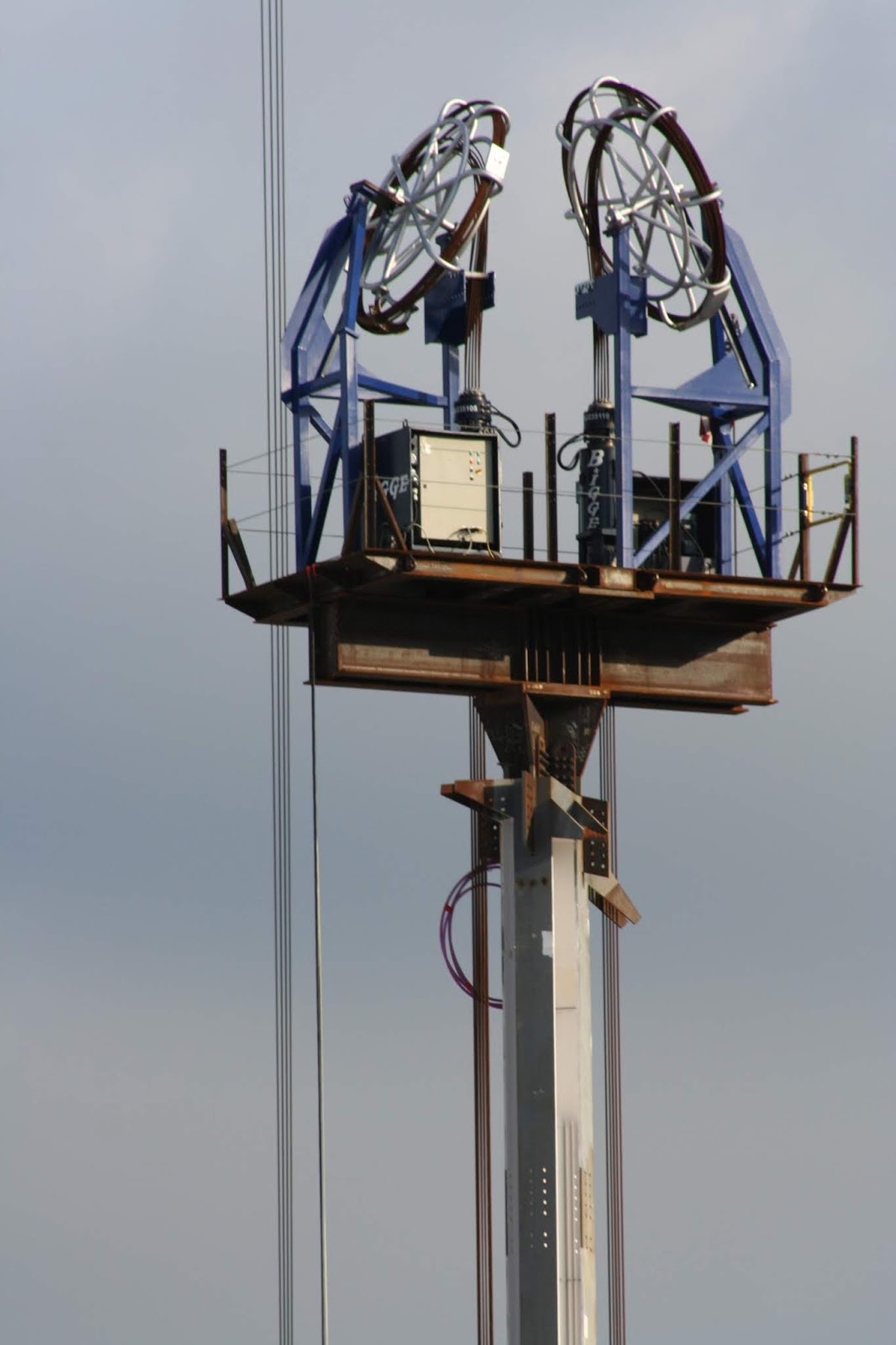
There's a lot of construction going on... ... and so there are a lot of cranes in the local Google landscape, including a bunch of very tall, very large, and very odd ones. So I was surprised when I saw tall poles on the construction site with what looks like wheels on the top. The obvious question: "What are these things?" Here's the original picture, and a closeup of what look like big bicycle wheels at the top of several of the vertical posts.
This is my original photo, taken on a run past a large Google construction site.
Here's a better, closer-up picture that I took yesterday...
Does this help? How about these pictures? In this one, you can see the wire ropes going up into the wheel--so we now know it seems to be something more like a reel (or spool).
1. What are these mysterious wheeled poles called? Why are there wheels on top? What do they do?
I finally figured it out, but it was a bit tricky. On the other hand, Regular SRS reader Jon (the Unknown) figured it out fairly quickly. In his first comment he wrote:
I got it before you posted this better image just now.
After a long, but interesting trawl thru construction sites of stadiums--I could see what looked like a floppy roof on the ground between them--I got onto roof lifter sites then found mention of 'strand jack'. Never heard of this but a quick click on images of strand jack I found lots of image hits like this one:
A "strand jack" recoiler. From Enerpac (heavy lifting technology company).
While that was great, I wanted to know more. So I wrote to Jon and asked for more details. He graciously replied with an amplified version of his SearchResearch process (lightly edited by me):
The scene you showed looked to be construction of an arena with an inflatable roof system; there are 8 of those wheely units around what I thought to be the roof cover. Spaced, I thought, just so, for that purpose.
So off I went with "construction crane parts" then I wanted to know how tower cranes extend and retract.
Back to your wheels now: "construction wheels on columns" then "to lift an inflatable roof with" and because you were close to it I started thinking to look in your area for a stadium being built which led to [ stadium san jose ] and [ Avaya stadium roof ]
Then sidetracked by ROOFLIFTERS and how entire solid roofs are lifted.
Back to the mainline: [ stadium construction lifting inflatable roof with ] and then sidetracked again by Tottenham Hotspurs on Instagram "roof lift" -- it's then that I see the first notice of a thing called a "strand jack"
Hmmm... Whats that? Then did a search for [ how strand jacks work ] finding lots of hits and leads. Then I ask [ strand jack recoiler ] which seems to be those wheels.
I also tried to find why the re-coilers are tipped. but could not find explicit reasons. So, back to my days working around wire rope and cranes and spools and winches. I think tipping helps to keep the strands clean and allow the natural lay or tendency of the strands, which are now not under tension, to lie in a natural way which also kept the pressure on most of the strand to not unwind.
So, what you (Dan) asked about are the recoil wheels. As the cable is pulled the excess can be wound around the wheels you see. Going the other way the wheels with strands of cable feed the jacking system. Used for very heavy lifts apparently. Great way to spend on hour on a rainy rainy day.
In my case, I futzed around for quite a while with combinations of search terms like crane, tower, wheels, etc.--mostly not finding anything. But then I found something interesting. Here's my recap of what finally worked.
Like Jon, I also (finally) figured out that this is probably a project to lift a roof. So I started with:
[ how to lift a roof ]
which gave me a lot of not great answers (they were mostly about how to lift small roofs). So I modified my query to avoid the "small roof" problem by:
[ how to lift a large roof ]
In the process, I noticed that a couple of the roofs were being lifted by hydraulic jacks. This was my ah-ha moment: "maybe," I thought, "this isn't a crane at all, but some fancy jack thing..." Could it be a hydraulic jack on a tower?
My next query was:
[ how to lift a large roof with a jack tower ]
which led to several web pages (e.g., "Dorman Long Jacking Towers") which had images like this:
The first place I saw "strand jack," in a diagram from the Dorman website.
Those reels and cables look a lot like the images above, the ones that caused the original Challenge. And there's a terms that's new to me--strand jack. What's that?
Like Jon, I first checked out the idea:
[ "strand jack" ]
(I double quoted it to find JUST strand jacks, both of which are common terms--but I only wanted that particular term.)
Guess what I found?
In particular, this sounds about right: The strand jack is a way to lift heavy loads with multiple jacks for construction. What's more, the yellow cylinders I see in the construction site images look a lot like the image above.
A quick image search with this query tells me that I'm getting close:
[ how to lift a large roof with "strand jack" ]
Now that I know this, this image now makes sense--these towers are strand jacks that will pull up the roof, a little bit at a time.
A close up of a strand jack at the construction site.
The cables go below and attach to a corner of the roof. Then, controlled by a master computer, all of the jacks lift their corner of the roof in parallel.
As you can see in the pictures below, the roof IS moving upwards!
How does this work?
It's a bit like pulling up a weight attached to a rope by hand. That is, you pull up with one hand, reach down, grab the rope with the other hand, pull that part up, and repeat.
Strand jack animation from Wikipedia page.
The red clamps hold the blue wire strands at both top and bottom, releasing the bottom and lifting up, then closing the top, then opening the bottom to effect the move. The orange hydraulic fluid is what does the magic. Put 13 of these side by side, and you can lift mountains (almost).
What I called "wheels" turn out to be more like reels or spools onto which the excess cable goes. A quick search for:
[ "strand jack" reel OR spool ]
quickly led to some useful images, like this one from Dorman showing the relationship between the strand jacks and the excess cable takeup reels. Here you can see the cables coming up from below, passing through the strand jack, and then up and into the takeup reels.
And, as Jon found out, these are often called "recoilers."
Know we know: The "wheels" are recoilers that take up the excess cables from the strand jacks that are (literally) doing the heavy lifting on this roof construction project.
And, here's a great video showing the strand jacks pulling up a very heavy load (a section of the new Oakland Bay Bridge), and the recoilers being used. (I didn't know the cables were wound up by hand, or as you can, by foot. In any case, there doesn't seem to be any motor involved!) Enjoy.
Search Lessons
This was an excitingly tricky bit of research to do. Here are a few take-aways:
1. Sometimes you need to take a broader view of what it is you seek. In this case, I really did NOT know what these things were. I had to start my searches for things that lift roofs... and work outward from there.
2. When you see a term you don't know, check it out! They're often terms (like "strand jack") that lead you to identification of the thing you're searching for.
3. Once you know the term, consider looking for images or videos that show the thing in context. It's an incredibly useful trick to verify that what you're seeing actually IS what you think it is.
Next week I'll spare you a Challenge to work on, but I will write a longer note about this particular SRS Challenge and reflect on the past year's worth of research.
More photos! I went over to the construction site and took a new photo today. It's below. If you click on the image, you can download the original (with all of the EXIF metadata).
This wasn't ideal lighting conditions for photography, but I did what I could. I also took my binoculars so I could get a close-up look, and found that the wheels actually have multiple loops of cable wrapped around them. The yellow boxes (one per wheel) seem to be motors that drive the wheels (but I'm guessing about that). In this closeup (from another pic), you can see that the wheels are both "tipped inward" towards each other at about a 45 degree angle. You can also see the cables, though it's not completely clear how the cables run from below other than they wrap a bit onto the wheel in multiple loops.
I'll try to get better photos later.. Perhaps tomorrow I'll remember my telephoto lens. We'll crack this Challenge yet! Searching on!
My father used to work for a crane and shipping company... ... and so I thought I knew a thing or two about cranes. I grew up around them, and as a young man, I worked for several summers as an "yard hand" (that is, the guy who helped string the wire ropes around things that the crane operator would pick up--so I worked with a lot of cranes.) But I was surprised when I went past a nearby construction site and saw number of cranes (or things that look like cranes)--with wheels on the top! The obvious question is "What are these things?" Here's the original picture, and a closeup of what look like big bicycle wheels at the top of several of the vertical posts.
This is my original photo, taken on a run past a large Google construction site.
Closeup of the wheeled things.
(I'll try to get a better picture tomorrow, but this will have to do at the moment.) The "wheeled poles" seem to have cables running down the sides but that's all I can see. They're mysterious, and therefore perfect for the SRS Crew. Can you do it? 1. What are these mysterious wheeled poles called? Why are there wheels on top? What do they do? That's it for this week. Just so you know, I don't have any idea what they are either. All I know is that they're about 20 meters high; each of the wheels seems to be about 3 meters in diameter (but I'm guessing). Beyond that, I can't see any identifying marks or logos. Tell us what you find... and HOW you figured it out! Search on!