Wednesday, July 20, 2022

SearchResearch Bonus Challenge (July 20, 2022): What's a large US city with very low population density?

 As I mentioned last week, I'm in a place with very slow WiFi... 


... so it's tricky to write up a detailed answer for you from last week. 

BUT a question came up in conversation about "what large US city has the lowest population density as of 2020?"  

There are tables one can find that will tell you one answer, but I'd like you to solve this Challenge in a more direct way--a way that will teach you how to download data directly into a table and then manipulate it yourself.  

Can you do this hands-on data manipulation Challenge? 

Here's what I want you to do:  

1.  Search for a table of the largest US cities by population.  You'll want to find a table with at least 330 entires in it.  

2. Download that table into a spreadsheet. 

3. Compute the population density (if you need to... it might be a column in the data set).  

4. Sort the table by density, and then tell us what the city name is!  

Your table should look like the one above (hint: I got it from Wikipedia, but you can find your own source if you'd like--the diversity of data sources might be interesting).  

This might feel like a bit of an odd Challenge, but it's a bit of a sensemaking exercise--can you get yourself through all the steps and get to the correct answer?  

Everything you need to know is pretty easily discoverable, and knowing how to do this will put you in good standing as a beginning data analyst--you'll know how to find data, import it, transform it (as needed), and then validate it.  

Can you do it?  

Let us know in the comments below!  

Search on!  


P.S.  My view at the moment.  Will wait to upload this post until I get close to good wifi.... 


Wednesday, July 13, 2022

SearchResearch Challenge (7/13/22): What is this rusty thing I found in the woods?

 As often happens... 

All photos P/C Dan. July 8, 2022

... I went for a run and spotted something remarkable hovering just behind the trees on the side of the road.  This time, I was jogging down a quiet country road in eastern Pennsylvania, in the middle of the Pocono mountain range, about 85 miles (136 km) due northwest of Manhattan.  It was a perfect day to run--cool, quiet, deep forest on both sides of the road.  Naturally, I had to stop for a few minutes, take a few pictures, and save my SRS for later.  

As you can see, this is a very large, very rusty, very old drilling rig that was abandoned years ago.  It's at least 60 feet (20 m) tall, and has several large wheels at the bottom. 


And, naturally, my curiosity was piqued:  What was this?  Why is it here?  How long ago?  


The pictures shown here are all of some kind of drilling rig.  These images are all from 41°16'52.9"N, 75°19'16.1"W (41.2813694, -75.323322).  

Those form the basis of the SearchResearch Challenge for this week.   

1. What kind of rig is this?  (Is it drilling for water?  Oil? Gas?)  

2. When was this drilling rig first setup?  

3. Who owns this thing?  And what's its current status?  (Obviously, it's not in operating condition--but it might still be a viable well.)  

Can you find out the answers to these mysteries?  The enquiring mind wants to know!  

It didn't take me too long to find out, but the process was--as we say here in SRS-land--really interesting!  

When you figure it out, please leave a comment in the thread below.  Let us know HOW you found out!  

Search on! 


P.S.  I'll be traveling over the next two weeks, so I might not be able to give the full and complete answer next Wednesday.  Hang on--I'll be back, and I'll return with even more interesting and exotic SRS Challenges for us!  


Wednesday, July 6, 2022

Answer: Why is there an elephant statue in this Wisconsin park?


An elephant in Delavan?


Seeing THIS in a mid-sized Wisconsin town was a huge surprise, and prompted me to look for the reason.  

(As I've said before, the most common motivator for SRS Challenges is something that doesn't quite fit in... something I didn't expect.  And I surely didn't expect a life-sized elephant and brightly painted clown in a small town parklet.)  

In any case, this scene made me look twice and take the pic, and it leads to the following SearchResearch Challenge: 

1. What's the story here?  Why is there an elephant in the middle of small-town Wisconsin?  Really?   I did a little digging and my mind is boggled.  Can any of this be true?  


I started with the obvious search: 

     [ elephant statue delavan wisconsin ] 

which gave me decent results.  But I ALSO tried a longer, more question-based query: 

     [ why is there an elephant statue in delavan wisconsin ] 

and THAT gave me rather different results.  Here's a side-by-side comparison of the two SERPs.  


In these two versions of the query, Google is trying to give you the best answers with-respect-to your underlying intent.  In the short query, Google is guessing that you're looking for information about the statues in Delavan--how to get there, nearby attractions, etc.  In the longer query (the more question-based one), Google thinks you're trying to find an answer to that question, "why is there an elephant in Delavan, Wisconsin?" and so it provides a more answer-base set of results, including an expanded snippet of information extracted from the first result (which is the same on both SERPs).  

But as you can see, the second result ("Romeo & Juliet") is pushed farther down the page, and generally, the results are rather different.  

What this means for you:  These days, Google is getting increasingly good at answering full questions, or at least trying to give you links to results that will let you answer those questions.

Note:  This doesn't let you off the hook... you still need to read and evaluate the results.  

This Challenge is a great example of why this is so.  

I opened up the top ten results in parallel in a single browser and looked at them in detail.  Fascinating.  

In #1, Statue of Romeo, we read that Romeo was just a bad elephant that killed 5 people in 15 years. He was infamous, and so the town (which had a rich circus history) decided to put up a statue commemorating Romeo and a circus clown.  

But in #2, Romeo and Juliet, we read that Juliet died one winter on the shores of Lake Delavan and was then pulled out onto the ice of the lake by Romeo, possibly explaining why he turned mean. This page goes on to say that "fishermen still pull elephant bones out of Lake Delavan..."  

#3 is a link to Wikimapia, pointing out the location of the statue.  

#4 is a story about Romeo and Juliet, claiming that "following the 1853 season, Romeo and a smaller female, Juliet, were sold to the Mabie Brothers and delivered to the show’s winter quarters at the present site of Lake Lawn Lodge..." on Lake Delavan.  (Which, coincidentally, was where I was staying while in Delavan.)  This story adds a tidbit--that Juliet died of a bowel obstruction, but repeats the claim that she was pulled onto the ice for deposition in the lake.  This article goes on to say that several elephant bones have been pulled from the lake since Juliet's death in February of 1864, during the height of the US Civil War.  There's a specific claim that "in 1931, a newspaper article documented the finding of a bone in Delavan Lake, which some thought to be from a prehistoric mastodon." 

The rest of the results are either recaps of these, or not especially useful. 

But what we've got here should be enough to figure out what the backstory is about Romeo and Juliet.  

This is obviously a job for a news archive, and my favorite of the moment is Newspapers.com (it's fast, accurate, broad, and available in many public libraries). 

A search on Newspapers.com for: 

     [ Juliet elephant Delavan ] 

and quickly located several articles from 1864 such as this one from the Semi-Weekly of Milwaukee, WI. On March 16, 1864, they published this short blurb about Juliet:  

P/C Semi-Weekly of Milwaukee, WI (3/16/1864)

There's no mention of her burial in the lake, nor of Romeo being forced into pulling her there.  All of the reports say the same thing: she died in February of 1864 at the site of the Lake Lawn resort (which was the Mabie circus company's overwintering site).  The ground would have been frozen in February, and I bet that a lake burial would have been the simplest solution.  

Although I tried, I couldn't find anything from those days about Juliet being dropped into the lake, nor about Romeo being forced to push her body into the waters.  

Nor was I able to find anything about the mysterious "mastodon bones" from 1931.  

So I turned to Google Books, and found several books (including the generally reliable Arcadia Publications ) about Lake Lawn which repeats the same story (Juliet died in winter, was pushed into the lake), Romeo goes on to kill 5 men, bones later found in 1931 thought to be mastodon... etc.  But, unfortunately, none of these seem to point to contemporary accounts.  It seems that the story of Juliet's burial-at-lake grew up sometime after her death.  It's certainly possible that it happened, but there's no confirmation by news reports at the time.  (At least not that i could find!) 

On the other hand, I did find a poster of the Mabie circus (there are multiple copies of this poster floating around).  

    The playbill describes "the gymnastic elephants, Romeo and Juliet..." as part of the menagerie. And, as you see, there are illustrations of them at the bottom of the page. 

The Clown:  To be honest, I didn't think much about the clown (after all, seen one clown statue, and you've seen them all).  But the comments thread was fascinating.  I'm quoting Mike's comment here (with a little editing):  

"I used to collect "First-Day Covers" ... specially decorated envelopes that contained a new stamp and was postmarked at the post office where it was issued.  

The 5-cent clown commemorative was issued BY the U.S. Post Office, of course ... but it was issued AT the Delavan Post Office.

A simple search [clown commemorative Delavan] brings up lots of info, including the philatelic industry's standard Scott Catalog ID number for this stamp (#1309) and a wide variety of versions (including First-Day Covers) for sale on eBay and other sites. Most interesting to me was the 26-page program for the first-day festivities, whose description included "It also describes Delavan's circus history, including circuses that originated or quartered in Delavan."

Also found was this article in the Linn's Stamp newspaper that said the famous clown Lou Jacobs was the inspiration for the clown used on the stamp.  

[Dan: I checked: Lou Jacobs was very clearly the model clown used for the stamp and the statue. Fascinating.]  

That led me to search for info on Lou, finding biographies on Wikipedia, and also a new "-pedia" to me: Circopedia - The Free Encyclopedia of the International Circus. 

Jacobs was in the first class (1989) inducted into the International Clown Hall of Fame, which was founded in Delavan in 1987, but moved to Milwaukee in 1997, and is now located in Baraboo, Wisconsin. 

[Dan: Interestingly, I found that one of Lou's daughter's, Lou Ann, became an elephant trainer.]  


Bottom line:  Romeo was a big and bad circus elephant that was famous in the 19th century.  He led a an unhappy life, and is commemorated as perhaps the biggest (literally) star from the circus town of Delavan, Wisconsin.  Hence the statues of Romeo, a clown (Lou Jacobs), and (nearby) a giraffe.  


SearchResearch Lessons 

1. No surprise, but not everything you read is true... even in books. To be precise, by doing everything I could to find some validation for the story of Romeo and Juliet, I was able to find that Romeo was in fact a killer, and a generally bad elephant (but also that he was terribly abused during his lifetime).  I was not able to verify the story of Juliet being dropped into Lake Delavan, although it seems plausible.  

2. Once again, archival newspapers are a fantastic resource.  Check out your local library to see if you have access to Newspapers.com  -- or, barring that, use one of the other archival news sites we've discussed (e.g., Chronicling America)  

3. Sometimes just asking the question is better than trying to guess the shortest possible query!  This is a big change from a few years ago.  When in doubt, try this first! 


Search on! 


Thanks again to Meredith Lowe, who first mentioned elephants and their bones in Wisconsin to me over coffee in Delavan. Thanks!  

Wednesday, June 29, 2022

Where's Dan? A slight SRS delay this week...


I knew I'd be traveling this week, 


.. but I also foolishly thought I'd have more time that reality allows.  You know how it is: your trip seems like it will be all perfect timing and a relaxing time, but then reality pours in new tasks to do, people to see, and questions to answer. And that's what's happened to me.  

This is actually a work trip, and by looking at the above pic, with the blue and white flag atop the church, you'll know exactly where I'm at.  Can you deduce my location from the flag alone?  (If not, it's open internet--I'm sure you can figure out what church this is...)  

I'll be back next week with my solution to the previous SRS Challenge (the one about elephants in Wisconsin).  

Search on!  


Wednesday, June 22, 2022

SearchResearch Challenge (6/22/22): Why is there an elephant statue in this Wisconsin park?

 I was driving through Delavan...


... a smallish town in southwest Wisconsin, midway between Chicago and Madison.  I drove past something so unexpected that I went around the block and parked just to be able to take this picture.  

To set the context, I'd been driving through lots of farmland, and then on several lakeshores.  On the road are the usual things (corn fields, tractors, bales of hay, pontoon boats on lakes, people fishing on bridges), but then I spotted this life-size statue of an elephant rearing up, threatening a clown.  

This made me look twice and take the pic, and it leads to the following SearchResearch Challenge: 

1. What's the story here?  Why is there an elephant in the middle of small-town Wisconsin?  Really?   I did a little digging and my mind is boggled.  Can any of this be true?  


Go ahead, dig into the backstory here and let us know what you find.  

MOST IMPORTANTLY:  How did you validate the story you found?  Is is possible to get to a clear / credible / valid version of this story?  

Search on! 


Idea credit to Meredith Lowe, who first mentioned elephants in Wisconsin to me over coffee in Delavan. Thanks!  


Wednesday, June 15, 2022

Answer: Why do gnats DO that?

  With my head in the clouds... 

... of gnats... I learned a few fascinating things by asking a few simple questions.   

As I mentioned, one of the defining features of being great at doing SearchResearch is having a deep curiosity.  In my work, I'm paid to be professionally curious, so I've developed a kind of permanently curious outlook on life.  As I'm reading, or as I'm walking around in the world, I constantly ask myself questions:  Is what I'm seeing actually what's going on?  What caused that to happen?  Why is this phenomenon taking place?  

And so it was when I was walking on the beach.  I saw the cloud of gnats circling around in a fairly tight swarm and wondered Why do they do that?  

One great strategy for thinking about Why questions is to think of similar situations.  In this case, What else flies in tight swarms, circling around a fixed point, rather than wandering off to another location?  

That thought is what made me think of starlings and their murmuration flights.  

So my Challenge was: 

1. Why do gnats and starlings murmurate?  (Is that even the right language to use?)  What's a good search strategy to find the answer?  Do they murmurate for the same reason?  

I have to admit that I've only ever read of starlings in a murmuration, but I specifically chose that word to break you, my dear SRS readers, out of a habit.  The obvious word would have been a "cloud of gnats" or a "swarm of gnats."  But one of the traits of doing good research is to have a wide-ranging vocabulary--it's important to be able to ask a question in a different way, if only to get a different view onto a common topic.  

"Murmuration" usually refers to starlings, but other birds (and animals) fly (and swim) in large groups in tightly coordinated turns, with different groups sometimes moving in synchrony, but in multiple directions, often forming lobes of groups staying more-or-less in one location.  This is not giant groups of animals migrating--those are flocks or herds or schools.  

While the starling murmurations are impressive, I wanted to see if it was ONLY starlings that murmurated, so I did a search for: 

     [ "murmuration of *" -starling ] 

to look for other kinds of murmurations, finding that red-wing blackbirds, pelicans, sanderlings, robins, flamingos, and many other kinds of birds murmurate as well.   (Pro Search Tip:  Note that I'm using the star operator as a kind of fill-in-the-blank search, along with the minus sign to avoid results with the word starling in them.)  

And of course, fish often do something very similar when they form "bait balls" to escape predators.  (See this great video from Blue Planet--watch at 1:05 to see a remarkable bait ball murmuration.)  

A bait ball of sardines. Large bait balls also murmurate. P/C OpenStax College


What about gnats?  

(BTW, what IS a gnat anyway?  It's important to know your terms when you start a search!  A quick definition search told me that gnat is a collective word for many species of small flies that do not bite. In some areas, gnats are also called midges. Gnats only live long enough to mate and lay eggs.) 

If you fell into my suggestion and did a search for: 

    [ gnats murmuration ] 

you probably saw some wonderful videos of gnats flying in clusters, BUT by looking down the SERP, you'll quickly learn that "swarm" is the preferred term for gnats (just as "murmuration" is the preferred term for starlings and birds, while "bait ball" is preferred for fish).  

So I'm going to modify my query to be: 

     [ why do gnats swarm ] 

and find a bunch of results, the first four which look to be from credible sources (a nature conservancy website, two science journal sites, and the U. Kentucky department of entomology), each of these with articles about "why do gnats swarm?"   

All of the sites agree: it's all about mating.  

The science news site tells us that 

"The swarms make it easier for the male and female gnats to find each other and mate..." and that "Gnats will often congregate around objects or other visual markers that contrast the landscape, such as fence posts...This helps the females more easily see in the swarm. [Turns out that] ...0nly male gnats swarm. The females then identify the swarm and enter it to mate."

Since gnats don't live very long, it's important to have a fast and easy way to find a mate.  Swarming is one very visible and simple way to do that.  Think of it as speed dating for tiny insects.  

But gnats are long-lived compared to mayflies: they live in the mud of a riverbed for up to three years before hatching.  After reaching hatching and growing to adulthood before emerging on the water’s surface, adult mayflies only have about three hours to mate. As you can imagine, this makes for a pretty frantic mayfly swarm. In these swarms, frenzied insects create a dramatic (and to some, dramatically revolting) congregation. One was so large that it appeared as a rainstorm on weather radar.  (For a video of a mayfly swarm, see this NatGeo video.) 

Interestingly, starlings seem to murmurate as a kind of group defense mechanism; it's difficult for a predator to track an individual when they're swirling around in a giant mob.  

By contrast, when gnats swarm, it's easier for some predators to fly through the cloud and pick up multiple meals at once.  (That's the way dragonflies will sometimes feed in swarms of gnats. This is so common that it's got a specific term: swarm feeding.)  

So what works as defense for the birds, doesn't work out so well for the little insects.  Well, if you're a mayfly, you're time limited, so procreation beats out your survival instincts!  


SearchResearch Summary 

1. Curiosity matters. It's not hard to develop the practice of being curious--it's just a matter of asking questions and then doing your SRS to find the answers.  It's a great way to learn about the world (and develop that little twinkle in your eye that leads you to ask, "I wonder if...")  

2. Be sure to check definitions.  I hope murmuration is now in your vocabulary, and that you know it usually refers to starlings (but not exclusively).  

3. Check for near-misses: What else is like this thing?  Up above I used the * operator along with the minus operator ( - ) to search for alternatives ("other things that murmurate, but don't tell me about starlings").  Once you know what else is nearby, you'll understand the large concept space--the specific answer to your question along with other things that tell you what's nearby or closely associated with it.  


As always... Search On!  

(And in Dan's addendum:  Stay Curious!!)  


Wednesday, June 8, 2022

SearchResearch Challenge (6/8/22): Why do gnats DO that?

 At the beach I ran into a cloud of gnats... 


... and maybe you have as well. Annoying, amirite? 

One of the defining features of SRS is a deep curiosity about things that you find, or in this case, you stumble into while on walkabout.  I grabbed this short video because I could actually see the gnats against the darker rock in the shadow.  They seemed to form an almost stationary cloud over this brighter patch of rock. 

I stood there for several minutes watching the cloud swirl around almost like a tiny murmuration of starlings.  I'm sure other people walking on the beach thought I was daft, staring at something they couldn't see, moving my hand slowly to see if they'd move out of the way.  (Answer: they'd dodge my hand, but the mass of gnats stayed hovering over the same place.)  


When I find something like this, I get curious and starting asking myself some basic questions: Why?  How?  What-for?  

And then I usually head home and search for deeper answers to the questions that rise to the surface.  (And if it's a really interesting thing I see, I write down the questions for later research.  As someone once said, "the most profound misunderstanding of human memory is that you'll remember that later...")  

So my Challenge for you, after my beach walk is this: 

1. Why do gnats and starlings murmurate?  (Is that even the right language to use?)  What's a good search strategy to find the answer?  Do they murmurate for the same reason?  

It's a great, curious thing to see beautiful behaviors in the world and try to understand them.  Tell us what you did to understand these behaviors.  Let us know in the comments below, won't you? 

Search on! 


Wednesday, June 1, 2022

Answer: Finding original patents?


Patents don't define a market... 

... but they're a decent proxy for when a market comes into being. This week's Challenge asks about finding the patent dates for two devices that are fairly clever, definitely deserving of patent protection.    

Can you find the patent dates for these two devices?  

1. What's the patent date for the apple parer seen above?  (See another view below for a similar device with an apple in place.) 


I remember that Google has a Patents corpus (Patents.Google.com), so I went there and searched for  

[ "apple parer" sargent foster ] 

-- surprise!  There were  NO results! 


When I did the search without Sargent, I found this patent for an "improved apple parer" (US116943, July 11, 1871), by Calvin Foster.  It's much more complicated than the device shown above, but it also slices the apples as they're pared.  


But I was expecting to find a patent with both Sargent and Foster's names.  And this isn't it--is there another patent?  

To explore a bit, I did a slightly different search without using the exact ("parer") term found in the advertisement--this was my second try at searching for the title (or claims) of the patent.  I used: 

[ apple paring Sargent Foster ] 

but as you might expect, there were a lot of results.  Luckily, the result I was searching for was in the 5th position: 


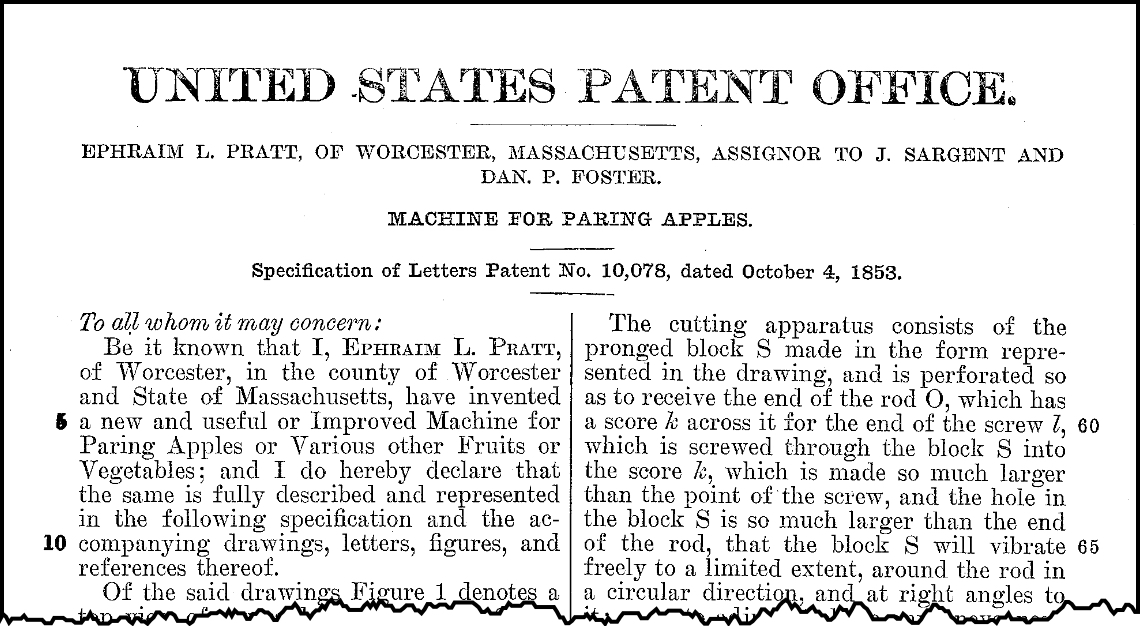
You have to read through the OCR failures ("Machine fob pabiwg" should be "Machine for paring apples").  Luckily, the full-text is recognized correctly, which is why my search for "paring apples" worked.  

I was curious if I could be more precise, so I put in a date restriction by using the Patents search UI.  Here you can see I put in Jan 1 1871 as the latest date I was interested in. (I just guessed this--looking at the style of the drawing, it looked like 1871 or earlier.)  Lo and behold, the search is very precise: 


This search returns exactly the one result for patent US10078A (1853), the "Machine for Paring Apples."  


With this as the original artwork: 
Note that the text "Apple Parer" is handwritten in the diagram. 
Apparently the OCR doesn't recognize that text in the illustration.  


Interestingly, it was invented by Ephraim L. Pratt of Worcester, MA, and then assigned to J. Sargent and Dan P. Foster, as shown in the "Sargent and Foster's Patent" on the top image.  

Assigning a patent transfers the ownership of the patent from the inventor (Ephraim) to the persons (or business) that will then own the patent. 

And now you can see the mistake I made in the first search--I found "An improved apple parer" by Calvin Foster, that was not the original invention by Pratt in 1864 and assigned to Sargent and Dan Foster I can speak from personal experience--"Dan" is not the same as "Calvin."    

As I poked around, I found even more patents by Ephraim Pratt--turns out he invented multiple apple paring inventions!  (Here's another one assigned to George Carter from 1864. 


Bottom line: patent US10078A  for the device shown above, was 1853, the "Machine for Paring Apples."  


2. And the device that captured my heart, a stapler that works WITHOUT staples!  When was this (or something very much like it) first patented? 


I was curious if I could find this using "regular" Google search, so I tried this search: 

     [ stapleless stapler ] 

and then looked at the images--was really surprised to see that there's an entire universe of shockingly colored stapleless staplers out there. 


But by adding the term "antique" to the query, I got much better results: 


 By looking at these results, it would seem that this is a "Bump Fastener" from the Bump Fastener Company of LaCrosse, Wisconsin.  (Notice that there's even chip in the upper left corner about "bump paper fastener.")  

Searching for [ Bump Fastener Company ] quickly got me to the official LaCrosse County Bump Fastener page, which tells me that "...this handy office tool fastens two or more pieces of paper together. The fastener cuts a small triangular-shaped hole in the paper, folds back the cut triangle, and then slides it into a slot cut in the paper to fasten it in place." And that it was invented in 1910.  

That's our gadget!  

(And yes, search-by-image works quite well, as does a Lens search.)  

But there's more to this history.  From the same web page: 

"Bump invented and patented other inventions while living in La Crosse, including an air compressor pump, a terminal clamp, a carburetor-adjusting mechanism, a rotary engine and many others. In 1930, Bump changed his company name to the Bump Pump Co., based on his new invention. However, the company was still producing his first patented invention, the paper fastener." 

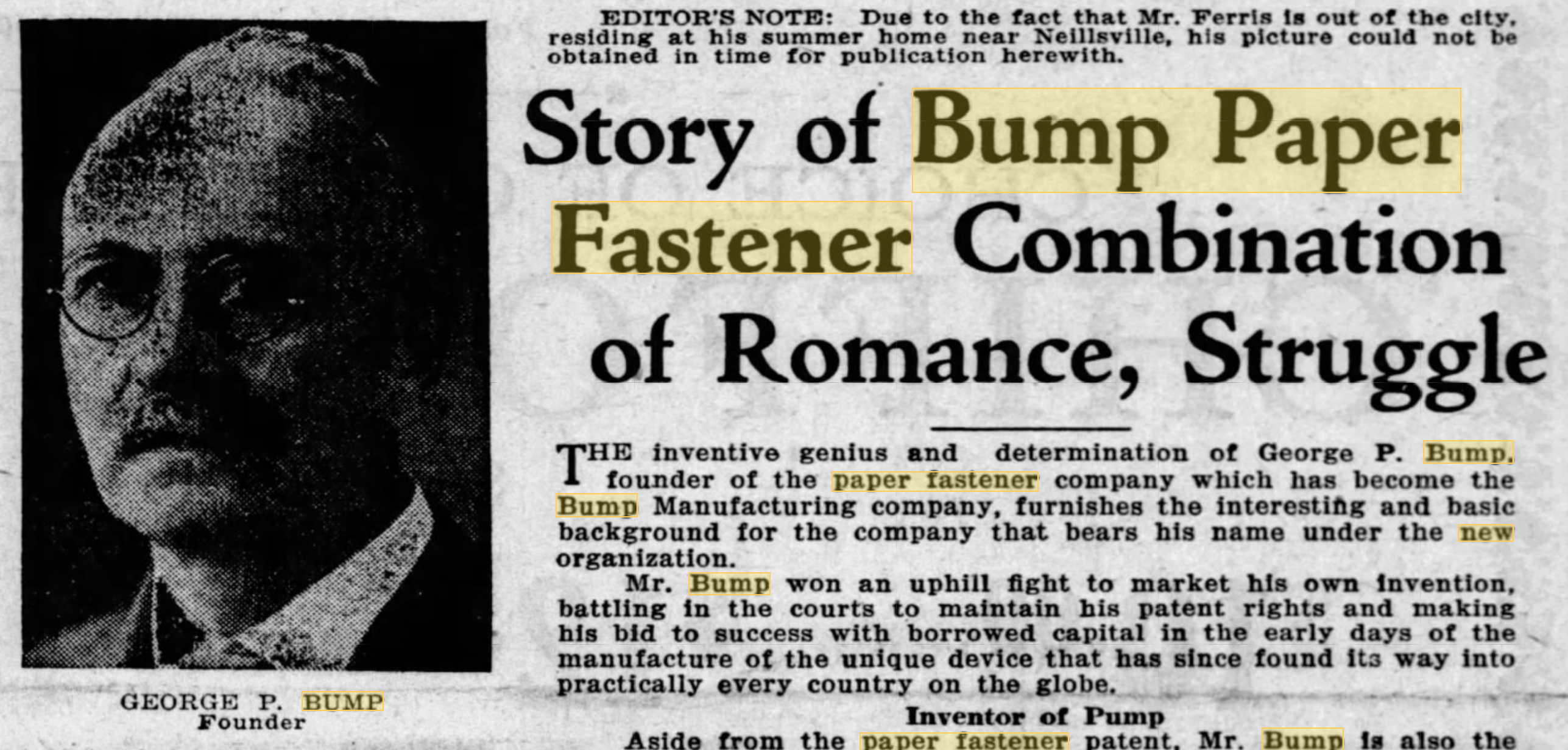
I have to admit that I was interested in the backstory, so I did the obvious search in newspapers of the day and found this lovely story:  

LaCrosse Tribune, 3 Aug 1930, before the company name change,

I'm not sure I would have called this a "Combination of Romance, Struggle," but things were different back then.  To LaCrosse, this was hot, front-page news!  

SearchResearch Lessons 

Before I get to the lessons I learned, I want to point out that several RegularReaders wrote exemplary SRS discussions and I want to point you to them. 

Art Weiss wrote about his great voyage of discovery (which I thought about using for today's text).  He also taught me about Espacenet, which is a great patent search engine--well worth knowing about. I especially like their advanced patent search UI which is especially easy to use.  

Remmij, as usual, found some intriguing pages, including a site I didn't know about, the Early Office Museum Website, which pointed out that "..[stapleless fasteners] were introduced in 1909 by the Clipless Paper Fastener Co. and in 1910 by Bump’s Perfected Paper Fastener Co. A Clipless Paper Fastener and the Bump Paper Fastener cut and fold small flaps in the papers in a way that locks the papers together.  Bump machines were still marketed in 1950.  Curiously, the model of the Bump Stand Machine that was introduced in 1916 was sold until 1950 with the words "Patent Pending." " 

Mateojose1 did a marvelous job of walking us through their search process with a nice description of side-journeys.  

Ramón points us to this amazing video of an 1870's peeler being restored and used.  Which reminded me to search on YouTube for a Sargent and Foster apple peeler video in use.  


My observations: 

1.  Read carefully.  I know I say this all the time, but when I was initially searching, I misunderstand Calvin Foster's name, thinking that only one person named Foster would be involved in apple peeler patents.  How wrong was I! 

2. OCR is inexact.. especially in older documents (like 19th century patents).  Sometimes you have to "read through" the OCR errors to get to the good stuff. 

3. Don't be afraid to try alternative versions of your query.  Note that when I tried searching on patents for "Apple Parer," it didn't work too well.  But "Apple peeler" did!  

4. Because this is the internet...there's a specialty group for everything.  On a lark, I did a search for just [apple parer] and found the Apple Parer Museum, which has a page just on the Sargent & Foster paring device.  Go figure. 


Search on!