Tuesday, October 24, 2023

SearchResearch Challenge (10/25/23): Three little Swiss mysteries?

 I'm currently living and teaching in Zürich until the end of the year, 


.. here in the heart of Switzerland. I'm teaching for this semester at the University of Zürich--and you only get one guess as to what I'm teaching.  That's right, I'm here to teach the course on Human-Computer Interaction and AI over the 14-week semester.

(In other words, what should we be doing to design and build AI systems so that people can understand and use them.  Hence last week's Challenge about getting LLMs to be useful in search tasks.)

But as a person who's relatively new to Switzerland, I've found a few things that are charming and puzzling at the same time.  Can you help me figure out what's going on in each of these cases? 

1. Why are these eggs colored orange/yellow?  I bought them in the local grocery store where they were sitting out on the shelf, unrefrigerated.  The label on the container says Schweizer Eier (Swiss eggs).  I've seen many different colored eggs from friends who have chickens (blue, green, brown, some with spots), still, this is extraordinary color.  But what's the story here?  What kind of chicken would produce these eggs?  


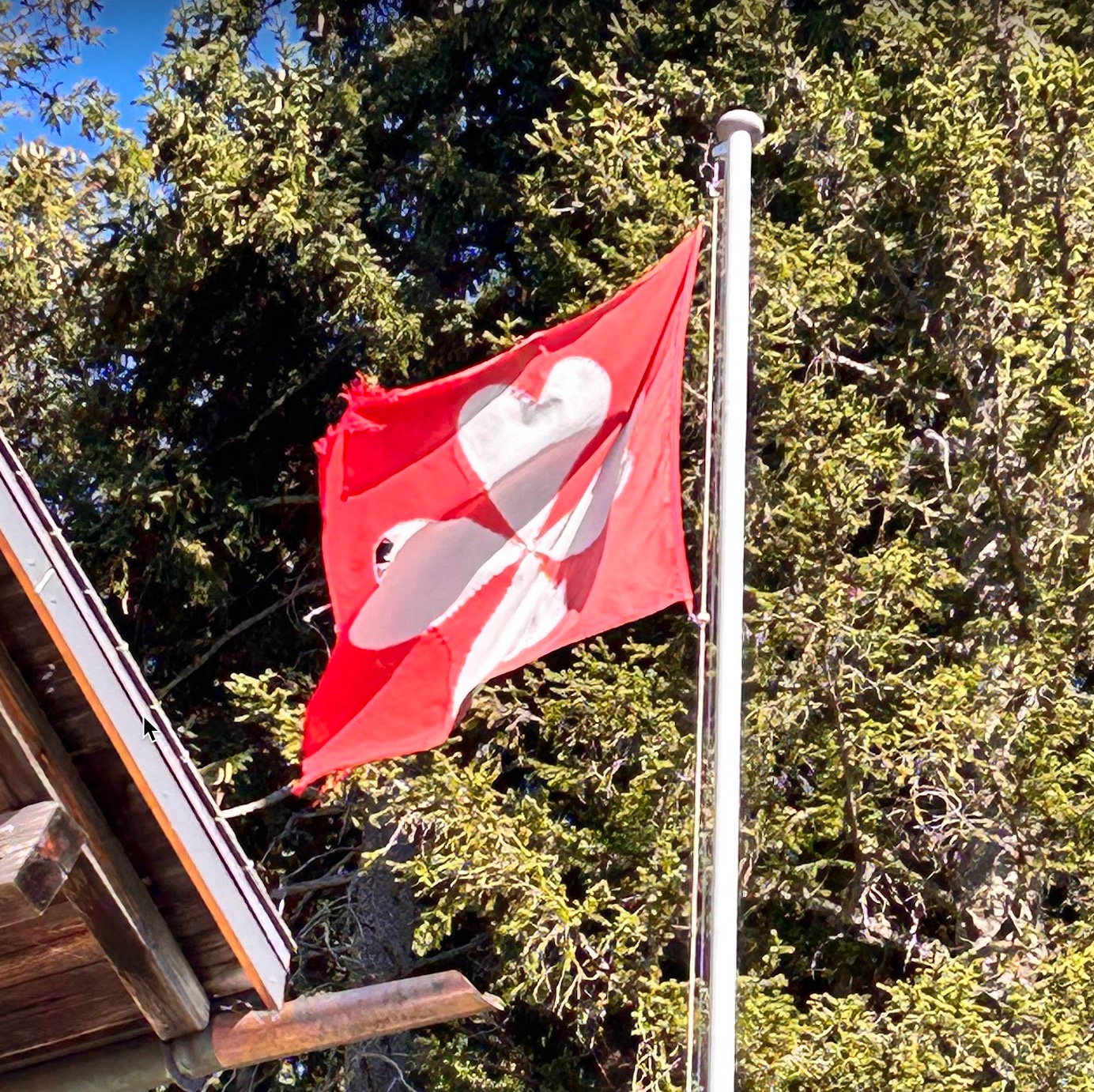
2. While on a hike in the Alps (near Rigi Scheidegg, if that helps), I came across this flag--and I have no idea what kind of a flag this is. What does it represent?  (It might help to know that the Swiss are a little flag-crazy. There is traditional Swiss flag-tossing (a kind of bucolic, even serene sport... watch the video), and flags seem to abound.  Given the level of vexillological interest here, it must signify something, but what?  


3.  I've seen some interesting vegetables before in farmer's markets before, but this one seems very Seussian to me.  What ARE these things? How would I eat one?  


Of course, we want to know how you found the answers to each Challenge.  Share your search tricks with us!  


Keep searching!  


Wednesday, October 18, 2023

Answer: How might we best use LLMs for online medical research?

 Can we count on LLMs for medical advice? 

Illustration by DALL-E of a medical scientist doing research

And it's pretty clear that LLMs and associated generative AI tools (see the illustration above, which is a lovely generated image by DALL-E) can come in pretty handy when given decent prompts.  

Our SearchResearch Challenge for this week was an open-ended Challenge intended to probe the limits and capabilities of high-stakes research.   

Here was the Challenge for the week: 

1.  What good advice can we give a person who wants to use an LLM for high-stakes research into a medical question?  We know people are doing this, and all of our ranting about LLMs won't stop them--but can we find ways of using LLMs and specific LLM/AI tools to improve the search process?  What would you say to people who are doing this?  (Aside from "be very, very careful.")  

I found some pretty serious problems in asking LLMs for medical advice.  The overall impression I have is that LLMs just are NOT ready for use in medical searching.  There are other possible uses, but asking an LLM for medical information is basically rolling the dice--you might get good info, and you might get terrible info.  My recommendation: 

DON'T ASK ANY LLM FOR MEDICAL INFORMATION,
especially diagnostic and treatment information  


I spent several hours testing out different kinds of prompts, testing out several popular LLMs.  This isn't all of the testing I did, but I'm summarizing so it doesn't go on forever and ever.  

I'm grouping my comments by three main types of failure: 

Citations are wrong (and if they're made up, what else is made up?): 

Bard:   

Prompt to Bard: "What is the latest literature on Glucagon-Like Peptide-1 Receptor Agonists (GLP-1 RAs)? Give citations for articles you mention." 

Bard totally made up citations.  Complete BS.  Example: Here is a purported summary of some of the latest literature on GLP-1 RAs, with citations for the articles mentioned:  

Bard: GLP-1 RAs may reduce the risk of all-cause death in people with type 2 diabetes. A recent study published in the journal Diabetes Care found that GLP-1 RA users had a 14% lower risk of death from all causes than people who did not use GLP-1 RAs. It suggested a citation: Zhang H, et al. Association of Glucagon-Like Peptide-1 Receptor Agonist Use With All-Cause Mortality in Patients With Type 2 Diabetes. Diabetes Care. 2023;46(3):503-511.)

But this is utterly wrong:  No such articles exist.  Given that, do you still believe the assertion that GLP-1 RA users have a 14% lower risk of death?  Where did it pull that from?  I have no idea, and neither does Bard.  

GPT-4: Interestingly, when I gave the same prompt to GPT-4 it gave real citations (after disclaiming that it was only up-to-date as of Jan 2022).  Interestingly, it did not try to summarize the literature (as Bard did), but just gave a few citations.  It also gave good advice about how to further the research task: "I recommend using databases like PubMed or Google Scholar and searching for terms related to GLP-1 RAs."   That's pretty reasonable. 

Claude:  Same prompt, but very different citations.  That's fine, they're real citations, but the summaries of the articles were fairly off--they seemed to summarize different papers than the ones they linked to!  What's up with that? 


Output is inconsistent with itself: 

Bard:  Here I'm intentionally asking a question that a patient might ask, "why is skin cancer more deadly than liver cancer?" knowing full well that this is the opposite of the facts.  

Prompt to Bard: "Why is skin cancer more deadly than liver cancer?"  

Bard:  Skin cancer is not more deadly than liver cancer overall. In fact, the 5-year survival rate for all skin cancer is 99%, while the 5-year survival rate for liver cancer is 19.6%. However, there is one type of skin cancer, melanoma, which is more deadly than liver cancer. Melanoma has a 5-year survival rate of 92.3%, which is lower than the 5-year survival rate for liver cancer.


Bard got the first part right, but the assertion that "melanoma has a 5-year survival rate of 92.3%, which is lower than the 5-year survival rate for liver cancer" doesn't make sense (how is 92.3 lower than 19.6?).  What's up with that?  

GPT-4:  Once again, ChatGPT-4 gives a pretty reasonable answer. First, it questions my assumption (that skin cancer is more deadly), and then lists reasons why people might consider some types of cancers more deadly than others.  It's quite a reasonable argument, and ends with reasonable advice about differentiating between different kinds of cancers when discussing prognosis and mortality.  

Claude:  Gives an answer much like Bard, but doesn't mix up the stats.  It's actually mostly correct. 


Don't trust reasoning of LLMs: 

I asked each of the 3 LLMs this question: "If it takes 3 days to clear up an infection with a 10 unit dose of an antibiotic, how long will it take if I use 30 units per day?" 

This, of course, is a terrible idea. Don't fool around with treatment plans!  

But when I asked Bard, it gave a quite reasonable framing of the question...  

Bard:  

It is important to follow the prescribed dosage of antibiotics to ensure their effectiveness and avoid potential adverse effects. Taking a higher dose than recommended can lead to various complications and may not necessarily clear up the infection faster.

In this case, if a 10-unit dose of an antibiotic is prescribed to clear up an infection in 3 days, it is advisable to stick to that dosage and duration. Increasing the dose to 30 units per day could potentially lead to adverse effects without necessarily shortening the treatment duration.


GPT-4: Gives a rather similar reply: 

I must preface my response by emphasizing that you should never adjust medication doses without consulting a healthcare professional. Self-adjusting doses can lead to unwanted side effects, antibiotic resistance, or ineffective treatment.

That said, based solely on the information you've provided and treating it as a theoretical exercise, the relationship between dosage and time isn't necessarily linear. The effectiveness of antibiotics depends on factors like... 


But Claude totally bobbled this one with an answer that's long on math and utterly missing common sense reasoning about drug therapy.  

Claude: 

Okay, let's think through this step-by-step: 

It takes 3 days to clear up the infection with a 10 unit daily dose of the antibiotic

So over the 3 days, the total dose is 3 * 10 = 30 units

Now we are using 30 units per day instead of 10 units per day

Since the total dose needed to clear the infection is 30 units:

If we give 30 units per day, it should clear the infection in 1 day

So in summary:

Total dose needed is 30 units

At 10 units per day, it takes 3 days

At 30 units per day, the total dose of 30 units is given in 1 day

Therefore, if the daily dose is increased to 30 units per day, the infection should clear up in 1 day.

Which is a terrible idea. 


You see where this is headed: Each of the LLMs has a very different training set, sets of guidelines, and text production models.  

In general, GPT-4 gives much more extensive answers to questions, and avoids summarizing technical medical texts.  I wasn't able to trip it up (but I didn't really push on the boundaries).  

By contrast, Bard always gives much shorter answers, frequently hallucinating reports and studies. 

And Claude is somewhere in the middle with middle-length texts, but will give answers that defy common sense.  (Don't ever modify your drug plan without talking with your physician!)  


What can we do that is useful?  

My direct advice would be to NOT ask for a diagnosis or suggestions for treatment.  That's probably still dangerous. 

On the other hand... I did find some value in asking LLMs for descriptions of medical conditions, therapies, and medicines.  This makes sense because there is a lot of training data out there on such topics.  So asking questions like "what is the IT band?" or "what are some side effects of taking cough medicine?"  


SearchResearch Lessons 

I could go on and on, showing all kinds of subtle errors and mistakes that the models make.  

1. Bottom line: They're not ready for medical advice.  They might be in the future, but at the moment, they're all too able to make errors that could be serious. 

2. They all give very different kinds of answers.  GPT-4 tends to give great details about a condition, going into enormous detail.  If that's what you want, go there.  For shorter answers at a slightly easier-to-read level, visit Bard.  

3. Compare and contrast.  All of the LLMs (including ones I don't mention here) have rather different outputs.  It's worth looking at them side-by-side.  

4. Don't forget your ordinary search skills.  Do I really need to say this?  Fact-check every thing, and look for important highly reliable sources in your quest.  

Keep searching!  

Wednesday, October 4, 2023

SearchResearch Challenge (10/4/23): How might we best use LLMs for online medical research?

LLMs are all the rage these days... 

Illustration by DALL-E of a medical scientist doing research

Some studies show that office workers who use LLMs (e.g., Google's Bard or OpenAI's ChatGPT) are more productive... on the tasks that they measured.  (At least that's MIT's department of economics conclusion.)  

And it's pretty clear that LLMs and associated generative AI tools (see the illustration above) can come in pretty handy when given decent prompts.  

Our SearchResearch Challenge for this week is an open-ended Challenge.  For these Challenges, I usually know what the "right" answer is and how to find it.  

But this week, this really is a call for the SRS community to help identify ways of using LLMs to do a very specific kind of research--a kind that we care a lot about--medical research.  Here's the Challenge for the week: 

1.  What good advice can we give a person who wants to use an LLM for high-stakes research into a medical question?  We know people are doing this, and all of our ranting about LLMs won't stop them--but can we find ways of using LLMs and specific LLM/AI tools to improve the search process?  What would you say to people who are doing this?  (Aside from "be very, very careful.")  

Maybe the point of using an LLM in "medical research" mode is just to help us to find really great search terms to use in regular web-search.  I'm not sure. But if so, let's figure that out. Are there other ways of using LLMs to get better results faster?  Or will the search for truth in LLMs be a bust?  

I'm focusing on medical research because it is high stakes, it's not okay to just skate on past little errors and unfortunate phrasing.  

A big problem here is that most of us are not medical experts, so it's going to be difficult to validate what the LLM tells you.  

My suggestion: Try doing a few medical search tasks in a medical area that you know something about.  Nearly everyone has been forced to become a mini-expert in some medical area.  I'm a mini-expert in a couple of really unusual types of cancer (family members, not me!) when I had to learn enough to make good recommendations to them.  So I can explore what an LLM tells me about that with some confidence that I'll have a basic understanding of an esoteric area.   

I'll be leaving comments in the thread this week (more than usual) as I work on this question as well.  

Let's figure out what advice we can give to LLM users.  

When you write your comments in the thread, be sure to tell us which LLMs you've been using.  (There are a lot of them out there, all with very different behaviors.  Let's be sure to keep our results limited appropriately.)  

And be sure to include the search path you followed (which now will include LLM prompts).  Mention the dead ends you found and strategies that just don't seem to work.  Negative results are really important here!  

Keep searching!  


Wednesday, September 27, 2023

Answer: What is dietary fiber?

 It seems obvious...  


.. but as I said, I suddenly realized that I didn't really understand what "fiber in my diet" really meant.  

This happens all the time. There's a kind of skill of recognizing that something isn't lining up--of knowing that you don't quite know what something really is. 

As you might have noticed, a lot of these posts start with "I didn't know..."  

In this particular case, I thought I knew was "dietary fiber" was.  Isn't fiber just the indigestible part of your food--you know, the little threads, husks, hulls, and tiny fragments that just pass straight through without much digestion seeming to take place?  

But as I noticed when I let my cereal sit for too long in the milk, things that say they have fiber in them (like my whole grain cereal) often don't look like there's anything fibrous within.  There's nothing like the kernels of corn or bits of apple skin that (as far as I can tell) are untouched by my digestive juices.  How could there be any "fiber" there?    

So... what is fiber really?  It's obviously not just undigested bits of food.  

Can you help me understand what's going on here?  Today's Challenges are: 


1. So what, really, is dietary fiber?  Is it something more than indigestible bits like wheat bran, corn kernels, and rice husks?  


I wanted to start with the basics.  First query: 
   
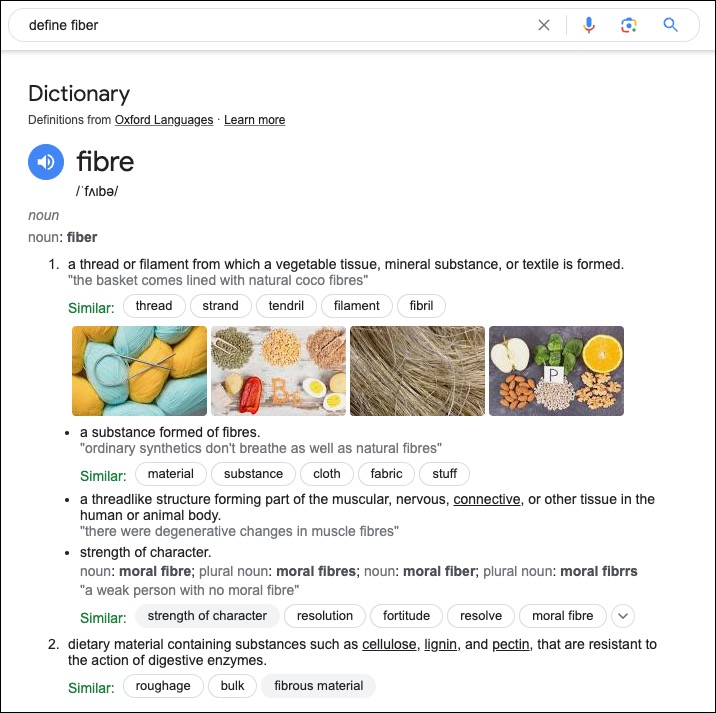
     [ define fiber ] 


This starts to untangle part of my confusion. I was thinking of dietary fiber as a kind of textile-like fiber.  That is, my mental model of "fiber in food" was based on what I thought of as a fiber that I might see in clothing or the husk of a seed.  This is very much along the lines of that word you see at the bottom of the definition, "roughage."  

But reading carefully, I learned that "fiber" (or "fibre") is also a "dietary material containing substances such as cellulose, lignin, and pectin that are resistant to the action of digestive enzymes." 

And THAT is a surprise. It means that the fiber in my diet can be pretty non-fibrous.  

Just a few weeks ago I had way too many plums on the tree at my house, so I spent a few happy hours making jelly and jam.  One of the steps in the process is to put pectin into the mix.  But when I do that, I can see that the pectin dissolves into a clear liquid... there aren't any obvious fibers that look like roughage.  

I was curious about lignin and cellulose, so I looked up those terms as well.  Are they fibrous in the way I'd expected? 

Answer: NO!  If you look at images of lignin, cellulose, or pectin, it's pretty clear that all of those come in powdered form--and if you look for [ liquid cellulose ] or [ liquid pectin ] it's pretty obvious that those don't have any roughage in them. 

So dietary fiber must mean something other than the roughage you get from (say) celery.  

My next query was for: 

     [ fiber in food ] 

and I quickly learned that fiber is, indeed, not just the rough indigestible bits, but is actually all the long-chain molecules that make up those indigestible bits!  

As the Wikipedia entry on dietary fiber tells us "Dietary fiber consists of non-starch polysaccharides and other plant components such as cellulose, resistant starch, resistant dextrins, inulin, lignins, chitins (in fungi), pectins, beta-glucans, and oligosaccharides."  

Okay.  I now know that "dietary fiber" is really all of those complex (long-chain) molecules in the food I eat.  So, "high fiber foods" have a lot of those chemicals AND roughage. 

But wait... there's more!  

I also learned by reading some of the links from the SERP that there are two kinds of dietary fiber!  There's "soluble" and "insoluble," that is, fiber that dissolves, and fiber that doesn't.  

     [ soluble insoluble fiber ] 

The first result is to the Medline page about dietary fiber, which includes this: 

"There are 2 different types of fiber -- soluble and insoluble. Both are important for health, digestion, and preventing diseases.

Soluble fiber attracts water and turns to gel during digestion. This slows digestion. Soluble fiber is found in oat bran, barley, nuts, seeds, beans, lentils, peas, and some fruits and vegetables. It is also found in psyllium, a common fiber supplement. Some types of soluble fiber may help lower risk of heart disease.

Insoluble fiber is found in foods such as wheat bran, vegetables, and whole grains. It adds bulk to the stool and appears to help food pass more quickly through the stomach and intestines." 

Ah ha!  So there really are two kinds of fibers in our food.  The soluble kind and the insoluble kind.  

Insoluble fiber:  This type of fiber does not get dissolved in the body and is also known as “roughage”, helping to clear out the intestinal tract. Since it's not broken down in the body, insoluble fiber has effectively zero calories. This is why a high fiber diet is recommended for weight loss as insoluble fiber will fill you up and pass through your body unchanged. 

Soluble fiber: By contrast, this kind of fiber is a bit more complex than the other. Unlike insoluble fiber, soluble fiber dissolves making a gel like substance, which is incredibly handy for slip/sliding your gut contents along.  


2. What is the current recommendation for dietary fiber in my diet?  Is 5 grams of fiber in a serving a lot?  Or is it a little?  

A quick search for: 

     [ dietary fiber recommendations ] 

generated a lot of hits.  Interestingly, when you compare the top 5 reputable sources, you see this: 

Mayo Clinic – Women:  21 to 25 grams / day; men: 30 to 38 grams / day
UCSF – everyone: 25 to 30 grams / day from food, not supplements 
NIH -everyone:  25-29 grams / day (more than 30 grams would be better) 
Harvard – people < 50 years, 25 grams for women and 38 grams for men. 
                For people > 49, Women and men should have 21 and 30 daily grams

Oddly, none of the sources break down the amount of fiber by soluble vs. insoluble.  But it's clear that "fiber from food" solves a lot of the soluble/insoluble question by providing both in roughly equal quantities.  

Basically, if you can dissolve the food in water, it's got soluble fiber.  If it doesn't dissolve, it's insoluble fiber.  You need both.  

Bottom line: Women need slightly less fiber than men, but everyone needs roughly 30 grams / day.  

If you look up various foods (after doing a query like [ data set food fiber amount ]), you'll probably end up on the USDA's list of foods with the amount of fiber listed for each.  In that list you'll see a lot of high fiber foods that you probably won't eat in large amounts (who eats 100 grams of cinnamon?), but you'll be able to look up your favorite foods and estimate the amount of fiber you're getting.  

US folks: Note that the table is given in "amount of fiber in 100 grams of food."   So you'll have a vivid image--100 grams is around 3.5 ounces, or to make it visually memorable, small cans of cat food are 3.5 ounces (100 grams). 

And you'll see that my favorite cereal has 10 grams of fiber in 100 grams of cereal.  But take note--most people I know don't eat 100 grams of cereal in a serving at breakfast.  My bowl of morning cereal usually has 36 grams of cereal, which means I'm getting 4 grams of fiber in each bowl. 
Apple with 2.8 grams of fiber

That's okay, I guess, but an average apple has 2.8 grams of fiber, and a regular serving of plain old oatmeal has 4 grams of fiber and 6 grams of protein.  (And it's about half the cost per serving.)  


SearchResearch Lessons 

1. Search out the things you don't understand, even sometimes fairly obvious things.  This was just one of those little things that struck me while reading: I couldn't actually define dietary fiber.  I make it a practice to question what I'm reading at a very basic level.  This is deeply important when you're reading something that's complicated or has an intricate back story.  Do you really understand all of the parts and pieces that are involved?  

Being a skilled searcher is, in large part, having enough background knowledge to know when something you just read (or heard) doesn't fit in with the other things you've read.  In this case, it was a small observation about my breakfast cereal.  For you, it might be something else.  Follow up those small questions--they could be deeply important.  

2. Look for multiple sources.  As I did with searching for multiple sources of fiber recommendations, it's easy to find them.  Be aware of differences between measurements! 


Keep Searching!  

Wednesday, September 20, 2023

SearchResearch Challenge (9/20/23): What IS dietary fiber?

 I realized I don't know what "fiber" really is!  


I was at a farmer's market buying a few veggies for the week ahead, and while standing in line I was browsing my news feed, and came across an article about the amount of dietary fiber in different foods.  I was impressed to read that my favorite breakfast cereal, a "high fiber" food, delivered a "whopping" 3.57 grams of fiber in each serving.  

Years of SRS have taught me to be very wary of anything I read, especially when it's surrounded by such superlative adjectives. 

So I found myself wondering my SearchResearch type of questions:  "Is that a lot of fiber?"  And "so how much fiber should I be getting?"  

When I got home I did a little searching around and found that... I really don't understand what fiber is! 

In particular, I thought that fiber was the indigestible part of your food--you know, the little threads, husks, hulls, and tiny fragments that just pass straight through without much digestion seeming to take place. 

But when I let my cereal sit for too long in the milk, I know it turns into a pure paste.  There's nothing like the kernels of corn or bits of apple skin that (as far as I can tell) are untouched by my digestive juices.  How could there be any "fiber" in that glop?  

Later, I saw a bottled drink for sale in my grocery store that promised a solid 6 grams of fiber in a single drink.  So far as I could tell, the drink looked pretty much like some kind of exotic juice--not the pulpy slurry I would have expected.  

Can you help me understand what's going on here?  Today's Challenges are: 


1. So what, really, is dietary fiber?  Is it something more than indigestible bits like wheat bran, corn kernels, and rice husks?  


2. What is the current recommendation for dietary fiber in my diet?  Is 5 grams of fiber in a serving a lot?  Or is it a little?  


These don't look like difficult questions--BUT--when I did my research, I found the story much more interesting and complicated than I'd originally thought.  

Among other things, I've started looking at the listed amount of fiber in a food product with a huge grain of salt.  (Which will then upset my sodium intake, but so be it.)  

What IS the story with fiber?   It seems there's more here than meets the eye, the tooth, and the entire alimentary canal.  

Can you find out? 

Let us know what you discovered, and what you did to find out about it.  

Keep Searching!  


Friday, September 15, 2023

Answer: A mysterious octopus? And the woman who understood.

  An octopus has eight arms... 

Gloomy octopus. P/C John Turnbull.

... and, even though it's a mollusk, it doesn't have a shell.  They do have a hard beak, but there's no shell in the ordinary sense of a mollusk.    

As I've mentioned before, there are exceptions to just about every generalization (even this one). A friend mentioned an octopus that DOES have a shell.  How can we find out about this?   Is that true?  Here are the Challenge questions for the week:  

1. Is my friend right?  Is there an octopus that has a shell?  Really? 

Let's start with the obvious: 

     [ octopus has shell ] 

and we quickly learn that it's complicated...  The short answer is "yes..but..."    

It's not hard to find that there are actually two octopus creatures (that is, they have 8-legs, in the Order of Octopoda).  One is the Cirrina sub-order of Octopoda--they have a small, internal shell and two fins on their head, and NO ink sack.  Here's a deep-water Cirrinothauma, often called the "Dumbo Octopus" for its resemblance to the Disney character.  

This dumbo octopus (Cirrothauma murrayi) is often called the blind octopod due to the lack of a lens and reduced retina in its eyes. Its eyes can really only detect light and cannot form images P/C NOAA

Then there's the other one--the Argonaut (Argonauta argo), a fabulous creature that also creates a very thin, papery shell that it uses to move up and down in the water column... but only the females do so. They are not attached to the body of the female.  But, oddly, they make the shell by extruding it from their body and then holding onto it for the rest of their lives.  

So the shell is of the Argonaut, but not part of the Argonaut.  They make shells for use as egg-cases.   By searching for [ argonaut shell ] I was able to find this lovely image of just the shell.  

Argonauta argonaut eggcase / shell. P/C James St. John (Flickr) CC by attribution 2.0

For our purposes, if the Argonaut creates it, we'll call it her shell.  This is what one looks like in the wild: 

The white shell is on the left, with the octopus eye and
tentacles sticking out on the right.

But then there's the more delicate issue of whether or not an Argonaut is an octopus or not.  It behaves a lot like a regular nautilus (it's got that nautilus-looking shell that it hangs onto), but the Argonauta argo is a genuine octopus that just seems like a nautiloid.  By comparison, a regular nautilus (e.g., Nautilus belauensis) has a very different body plan.  In this image you can see the outside and the inside of an "ordinary" nautilus shell.  

Exterior and interior of a nautilus shell showing the chambered interior construction

As we've talked about before, these distinctions are important when you're doing your online research.  

Early illustrations of the Argonauta. P/C Wikimedia. Original from Natural History: Mollusca (1854), p. 22 - "Paper nautilus" [Argonauta]

For a wonderful paper about the Argonauta (in particular, with great details about its shell), I highly recommend the paper Recognising variability in the shells of argonauts (Cephalopoda: Argonautidae): the key to resolving the taxonomy of the family Memoirs of Museum Victoria 77: 63–104 (2018).  


2. As I read more, I learned a couple of fascinating details about the life of this particular octopus.  Can you find two really unexpected things about this animal? 

There are many remarkable things to notice about the Argonauta argo, but perhaps the two most remarkable things I picked up just by reading. 

A. The Argonauta argo controls its buoyancy by scooping air into its shell while on the surface. With this little bubble of air, it can hover easily in the water column.  By contrast, other octopuses linger at the bottom of the sea.  They can swim around, but they prefer to hide out on the bottom.  The Argonauta defies this with its mid-water behaviors.    

B. The little octopus can repair its shell!  The shell is large, but has thin walls with just one chamber (not like the chambered nautiluses above).  The material of the shell is high in magnesium, but is primarily a kind of calcium carbonate. The biggest surprise to me was learning that if the shell of the paper nautilus is damaged, a female can repair it or can completely rebuild it as needed. 

C. Males have a modified sex arm called the hectocotylus.  When mating, the hectocotylus detaches from the male and is left inside the body of the female.  Sometimes, mature female Argonauts are often found with multiple male hectocotyli (each from a different male) wrapped around the gills inside their mantle cavities. When this was first observed by naturalist Georges Cuvier, it was thought that the hectocotyli were actually a kind of worm.  Seems like a strange mistake to make, but the hectocotyli are small and, lets face it, kind of worm-like.  If you see several of them wiggling around inside of a female Argonaut's mantle cavity, you too might think they were worms.  

I could go on... but I'll let discover more about these strange and wonderful creatures on your own. 


3. Who was the woman who first did serious research on this octopus?  What essential piece of research gear did she invent?  

Since the argonaut octopus is such a wonderful animal, I was curious about who did the first research on the topic.  My query was: 

     [ first researcher argonaut octopus ] 

Note that I added the term "octopus" in order to get better, more focused results. But once I did that, the results were great.  

Who was Jeanne Villepreux-Power

Jeanne Villepreux-Power  P/C Wikimedia

She has a remarkable story.  Orphaned at 11, began working as a seamstress in Paris, married an English merchant and moved to Sicily where she began an intensive study of geology, archaeology, and natural history.  While walking on the beaches near Messina she came across the washed-up shell of the Argonauta and started studying them.  In the process, she invented glass-sided aquariums for research purposes, devising clever ways to work with the difficult Argonauts.  

Just as importantly, she published her work as a member of the Zoological Society of London.  Unfortunately, much of her work was lost in a shipwreck.  

But she was the first to show that the Argonaut can create its shell.  At the time, some thought that they stole the shells from other mollusks.  But Villepreux-Power showed that the paper nautilus actually secretes its own shell material. The ability to generate the shell also lets the creature add onto its shell to make it ever larger, and then repair the shell if it breaks (or if a malicious scientist comes along and breaks off a bit).  

SearchResearch Lessons 

1. You may find more than you bargained for!  When I started this research, I thought there was only one such octopus. I was very surprised to learn of the Cirrina sub-order of Octopoda.  I then found myself in a rathole making sure the results I was finding were about the Argonauta argo, and not the "classic" nautilus.  Be careful when you find a lot of results--be sure the thing you're reading is actually about the target of your search.  

2. Reading matters.  One thing I notice about young searchers is a remarkable ability to NOT read the articles they find. Reading in detail (or syntopical reading) is a real skill that you should practice.  That's how you find the most remarkable observations.  (Such as learning about hectocotyli that look like worms...)  


Keep searching.  

 🐙


Wednesday, September 6, 2023

SearchResearch Challenge (9/6/23): A mysterious octopus? And the woman who understood.

 I thought I knew what an octopus was... 

Gloomy octopus. P/C John Turnbull.


... they're the ultimate shape-shifter with an amazing ability to solve puzzles, slip through tiny holes, and possessed of a fascinating kind of intelligence.  I've watched them for hours while scuba diving, and I have to admit--they're probably my favorite undersea animal.  (Full disclosure: they're SO interesting that I can't eat them any longer--it would be like eating a very smart pet house cat.)  

But my understanding of them was as a shell-less mollusk.  Their bodies are as close to fluid as you can imagine--they flow rather than walk.  Even so, as they move across the ocean floor, they seem to move as an ensemble, rather than just as a single animal.  That's NOT what I think of as an octopus.  This video of a mimic octopus moving around, shifting shapes and colors--that's an octopus.  


https://www.youtube.com/watch?v=Wos8kouz810 

But when I was talking with a scuba-diving friend, they mentioned that there's a kind of octopus that actually DOES have a shell.  This claim, naturally, leads to today's Challenges--one about the surprising octopus, and the woman who did the first serious research on this remarkable beast.  


1. Is my friend right?  Is there an octopus that has a shell?  Really? 

2. As I read more, I learned a couple of fascinating details about the life of this particular octopus.  Can you find two really unexpected things about this animal? 

3. Who was the woman who first did serious research on this octopus?  What essential piece of research gear did she invent?  


I love Challenges like this.  It's not hard to find the answer, but once you know, it's hard to stop from reading more about this particular octopus and about the researcher who understood more than anyone else.  Trust me, there are many more than 2 "fascinating details" about this very surprising octopus.  

Let us know what you've found by leaving a comment here.  Enjoy the SearchResearch!  


Keep searching.