Thursday, January 27, 2011

Answer: How much fish passed through the Vladivostok port in 2010?

Nice job, Fred, Tasha and Daniel!  Wonderful comments!  


While there are many ways to solve this problem, I realized that the most likely authoritative source for this kind of information would be--guess what?--web pages on Russian sites.  (Which is the method Tasha used in her solution.) 


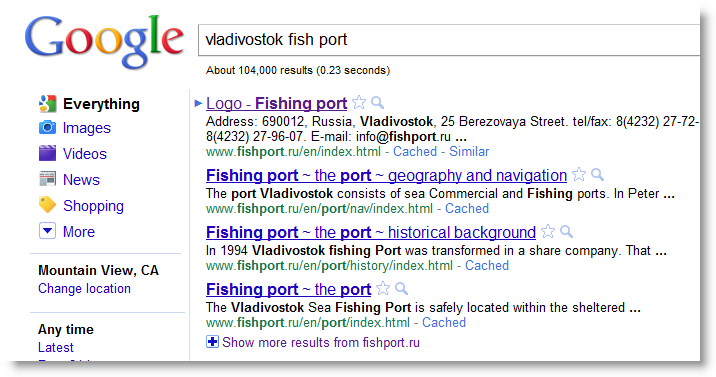
So I used the "Translated foreign pages" under the "More search tools" link in the left hand panel. 


With the "Translated foreign pages" option selected, you can search in English, and the best matches (in whatever other languages) will be shown in the search results, translated.

In this case, since we're interested in the Vladivostok fish tonnage through the port, nearly all of the pages will be in Russian.

With just a few clicks, you can get multiple pages that list the total fish tonnage.

However... if you want to be clever, you could use the pattern-match feature and do:


[ vladivostok port  " * tons of fish" 2010 ] 

(Note that I used the asterisk as a pattern match in the quoted phrase.  I figure that somewhere in an article about the fishing capacity of Vladivostok it would say something like "and the capacity of the port is XX tons of fish.")

The remarkable thing is that this pattern will match in English against Russian documents, and show one possible answer in the snippets...


Still, getting answers from snippets can be dangerous, so I clicked through to the top three to see what kind  of page each was and to double-check that the value was correctly in context.

The first result is from Novostivl.ru, a newspaper with fairly extensive business coverage for Vladivostok and the region, they give the 2010 catch as 1.5M tons.  The second result is from VestiRegion.ru (a Vladivostok newspaper) and confirms the port tonnage as 1.5M tons (1.6M for the entire region).

So my best guess is that it's 1.5M tons; several local news sources agree (and a quick extrapolation from the size of the Vladivostok harbor and the number of fishing vessels show that this is a pretty reasonable number... for vessels fishing in the north Pacific).

Search lesson:  When looking for information from another country, often your best source is local news from the country of origin. And the fastest way to get that information is via Translated foreign pages.  Don't forget this easy access to pages from other languages / other cultures.

Search on!


Wednesday, January 26, 2011

Wednesday Search Challenge (Jan 26, 2011): How many tons of fish in Vladivostok?

This is another relatively simple search task... IF you know how to approach the problem.  


This is a variant of a question that I was asked by a friend doing research into the Russian economy, and I've extracted one sub-question for your consideration:  


     How much fish (by weight) went through the 
     Russian seaport of Vladivostok in 2010? 


Simple to ask.  And relatively simple to answer.  


Can you figure it out?  


If so, send in a comment (and tell us the method you used)!  


Search on! 


Friday, January 21, 2011

Answer: What's that statue in front of the Grand Hyatt in Tokyo?

As written, this isn't that difficult of a question.  You can just look up Grand Hyatt Tokyo on Google Maps, then switch into StreetView to get a pretty good look at it.  When you look at the map, it's easy to tell that the Hyatt is next to the Mori Towers, in the region of Tokyo known as Roppongi Hills.  


You can check the Photos layer at that location, but I didn't spot any good images of the sculpture there.  (That's often a great resource for questions like this because people will take pictures, geo-locate them and label the things in the picture.  Not this time.)  


So we found the first answer to my question... 


What is it?  It's a sculpture of a mini-landscape.  By zooming in on the StreetView image, you can pretty easily see that it's supposed to be some kind of mountains, and you can (in some angles) see that there's a little waterfall in the sculpture.  


But you know me--now that I've got that little bit, how could I figure out what this sculpture is called and who the sculptor was? 


Getting this last little bit of information was tricky, but my solution leads to a great insight for real searchers and real search tasks.  


I tried all of the obvious searches ( [ tokyo grand hyatt sculpture ]  [ roppongi hills sculptures ] and so on... nothing was working).  


After about 45 minutes of plugging away like this I realized that I was going to need a different strategy.  


I sat back in my chair and though "Well... who would know what this thing is called?" and the answer hit me like a World Book encyclopedia dropped from 30,000 feet as the jet of thought passed overhead:  the concierge at the hotel would know.  


Now you might think this is cheating, but I don't think so.  I'd tried about 20 searches, and when you've done that many searches, it's a strong indicator that something is wrong.  You really need a different approach.  And people are great information resources.  


Besides, Google helped out here too.  I just went to my GMail and used the "Call phone" function.  I did the obvious search for [ Grand Hyatt Tokyo telephone ] and got the direct number in a couple of seconds.  I asked for the concierge and had the answer about 15 seconds later.  


If only I'd thought about this 44 minutes ago! 


For the record, the concierge at the Grand Hyatt Tokyo (who was a lovely person and incredibly helpful, I might add) told me that the sculpture is entitled "High Mountain, Flowing Water" by Chinese artist Cai Guo-Qiang.  


Armed with that information, it's an easy search:


 [ high mountain flowing water cai guo-qiang ] 


The first hit is the artist's web site, that tells us the full name of the sculpture is  High Mountain Flowing Water: 3-D Landscape Painting,  and was  Mori Arts Center, Tokyo, commissioned by Mori Arts Center, Tokyo and put into place in Oct. 2003.  And his website has this much better photo... from the parking lot, not from the street.  


High Mountain: Flowing Water: A 3-D Landscape Painting
Cai Guo-Qiang (2003) 


Search take-away?  Sometimes a phone call to a live human can VERY quickly give you the few additional bits you need in order to get to information that's otherwise impossible to deduce.  


Remember--all this search stuff isn't a closed-book test.  It's open Internet, open brain, open world.  


Search on!  


Thursday, January 20, 2011

Wednesday Search Challenge (Jan 19, 2011): What's that sculpture in front of the Hyatt in Tokyo?

This week, a somewhat easier puzzle.  


I'm in Tokyo on a business trip, and that leads me to the following little puzzle.  


Can you figure out what the sculpture is in front of the Grand Hyatt hotel in Tokyo?   It's the sculpture at the main outside entrance.  


(Just a description of it would be good enough.)  


Search on! 


Friday, January 14, 2011

Quick check on the validity of an image

Did anyone else see that amazing image of the International Space Station shown in sihlouette against the sun?  


http://media.npr.org/assets/img/2011/01/06/eclipse110104_solar_transit_33.jpg 


I wondered--is that even possible?  Or is this a completely Photoshopped image?  


First, how big is the ISS?  Here's a picture from NASA to give a sense of scale: 


In other words, it's about one flying-football-field.  


How big would a football field look if if were flying at the altitude of the ISS?  


Well... here's a bit of math I did to do a quick check on it.  

I did a few obvious searches to figure out that the ISS is 109m maximum width and flies at an average distance of 350km.  With these two bits of info and a little geometry, you can work out what the subtended linear angle of the ISS would have to be.  The geometry is easy... 

54.5m is half the ISS width, which you need as the base of the triangle.  278.000005 is the length of the hypotenuse according to Pythagoras.) 

To work out the subtended angle, you just compute the arcsin ( 54.5m / 278.000005km ) -- that's about 0.011 degrees.  


Luckily, this is really easy with Google.  

How did I do that?  Once I'd worked out the hypotenuse length (350.0004 km) I just turned to Google Calculator.  Here's my query: 

     [ arcsin ( 54.5m / 350.0004 km ) in degrees ] 

That is, this bit of trig computes "what is the subtended angle of the ISS?"  


( NOTE:  I added "in degrees" at the end because the Google Calculator gives back sin/cos/tan/arcsin... (etc) measurements in radians.  But I wanted degrees, because I happen know (from another query) that the sun is 0.53 degrees wide.  )


This Google Calculator expression tells us that half the ISS width is 0.008 degrees wide (remember, we divided the image in half in order to do the right-angle trig up above).  So the subtended linear angle of the ISS at 350 km overhead is 0.016 degrees.  

So... 

... if you measure the photographed width of the ISS in the image, the width of the ISS image should be about 1/50th the width of the sun image.  (How do I know what?  The subtended linear angle of the sun is 0.53 degrees.  Divide 0.53 by 0.01 and you get 53.  

I measured it quickly by doing a little copy/pasting on the image (see below), and got it at 1/52cnd... close enough.  (That's well within measurement error on my part.)  Here's the diagram I drew to measure it.  I took the image and drew a light blue line below the ISS that's exactly the width of the ISS.  I then drew a bunch of dark blue bars that same width across the radius of the sun.  


Each of the dark blue bars is 1 ISS width.  Each of those light blue lines is 10 ISS widths across...  so it looks to me like the sun is 52 ISS widths wide. 


I also looked around a bit, and found multiple OTHER images made by other amateur astronomers, all showing the ISS at more-or-less the same size with respect to the sun. 


Overall, the picture checks out. It's internally consistent (that's why I was measuring it) and it's been replicated by other astronomers.   So yeah... I believe it.  


What a beautiful image! 


Search (and measure) on! 


Thursday, January 13, 2011

Answer: Where is the Sea of Gazelles

As I mentioned, this isn't that hard, but this is one of those cases when it helps to know about the use of double quote.


Generally speaking, double quotes, as in the query: 


[ "Sea of Gazelles" ] 


finds that exact phrase "Sea of Gazelles" (note that the capitalization doesn't make any difference).  


Contrast this with the query: 


[ Sea of Gazelles ] 


...which is dominated by ships with the name Gazelle and gazelles, the antelope.  When you see this kind of thing (that is, the exact phrase not begin found), that's your cue to try using double quotes to find the phrase.  


Once you do it this way, you can find that the Bahr al Ghazal (translates as the "Sea of Gazelles") is a river in southern Sudan (in Arabic, Ø¨Ø­Ø± الغزال) that connects to the White Nile in the southeastern part of Sudan.   The Bahr al Ghazal drains a basin larger in area than France, and although the drainage area is large, most of the water evaporates from the slow moving stream, and the discharge of the Bahr al Ghazal into the White Nile is minimal.  


Locating the exact location of the "Sea of Gazelles" is tough--but we can find the White Nile and the location of Lake No, which is the place where the wide and broadly flowing Sea of Gazelles enters the collection point. 


To find Lake No, I just went to Google Maps and did a search for [ Sudan ], then [ Lake No ]  I did it in that sequence to make sure I got the "Lake No" in Sudan, rather than some other Lake No elsewhere in the world.


Now, to get the lat-long, I just activated one of the Lat-Long tools in Google Maps Labs. 


To get this, click on the "New" button in upper toolbar, which will show you this set of options: 


I activated the LatLng Tooltip, and then just shift+clicked on the map at Lake No.  


So... the lat-long is pretty clear:  9.4883, 30.454. 


It's handy to know that you can just type (or paste) a Lat-Long into Maps.  (Ever wonder where 0,0 is??  Try it and find out.  Or.. for a more interesting location: -10.4838, 105.6356 )  


Take aways: 


(1)  Consider using double quotes to search for an exact phrase when your results are for other interpretations of your words.  
(2) When searching Maps for features in other countries, it's handy to search for the country first, THEN the specific feature within that country (to shortcut the problem of figuring out which of many alternates you really want). 
(3) Determine the Lat-Long of a point by activating the Lat-Long tool from Maps Labs.  


Search on! 

Wednesday, January 12, 2011

Wednesday Search Challenge (Jan 12, 2011): Where is...

It's a simple request, really.  A friend was reading a book and ran across a reference to the Sea Of Gazelles.  


The challenge today is pretty straightforward:  Where is it?  (Specifically, can you give a lat/long for this place?  In the middle of it will do...) 


This time, I know it's a real place--and there's a small trick to finding it rapidly and accurately.  


Search on!  

Saturday, January 8, 2011

Answer: Finding a story... FAIL!

I knew this day would come, and it's finally arrived.  We've been stumped.  


Lots of people worked on this, and several regular readers (Mark, gnetiq, Fred, Ahniwa) all left good comments and leads.  But nothing's worked out.  


To tell you what I've been doing... I posted this problem on a few social answering sites (Yahoo Answers, Answerland) and on a listserv that's devoted to answering exactly this kind of problem--that is, identifying stories and books from the merest of clues.  As it turns out, there's an entire community of librarians that face this problem every day--someone walks into the library and asks for "Poor and Wease" -- you have to know that what they meant is "War and Peace."  


So I signed up for the Fiction_L listserv and posted my question there.  (Side note:  It's been really interesting to see the kinds of questions people ask librarians.  "Can you find me novels set in Montana?"  I recommend it as a source of ideas about how people think about their difficult search problems.)  


SUSPENDED!  But nothing has worked so far.  So I'm going to declare this question SUSPENDED pending additional information or sudden discovery.  If (when!) we finally figure this one out, I'll be sure to do an analysis of HOW we could have found it (assuming we could).  


At this point, though, if I were a librarian, I'd be suspicious of the recollection.  As we've discussed before, recall of movies / books / short stories is very error prone.  It's not that individuals just have weak memories, it turns out we all recode what we experience, and then those recollections evolve over time.  Memory for an incident (or book or ...) isn't fixed into memory like an etching into glass, but it's lightly written and subject to weathering--more like water colors on rice paper that's left in the sun and elements of subsequent experience.  


by Peter Pirolli
As my friend Peter Pirolli points out in his work on Information Foraging Theory, you work on a problem until the expected utility of the next action (more searching, in our case) exceeds the total expected value of the work.  That's when you give up--when it just doesn't seem as though more work is going to yield anything.  


Pete's work was informed by some great studies of hummingbird's feeding in Alpine environments, where they have to choose when to move to another patch of flowers.  They move when the next search isn't likely to be successful.  


That's the situation we're in at the moment:  this information hummingbird needs to move onto the next food source, the next item on the dinner menu.  


But we'll remember this, and come back if the flowers re-open.  


Keep searching!  

Thursday, January 6, 2011

Thursday--Search Challenge continues for the short story!

This one is officially hard.  


At some point we'll have to give up on it--but at the moment I'm working my social network after spending around 60 minutes on regular search.  


Anyone else have more luck than me? 


Searching on!  (At least until tomorrow.)  

Wednesday, January 5, 2011

Wednesday Search Challenge (Jan 5, 2011): Finding a short story

This might well be a toughie.  I've spent about 30 minutes so far without any luck.  Can you do better? 


My friend Josh writes:  


I'm searching for a short story.  


The plot: A king lives in a castle at the edge of a bottomless cliff.  The taxes are too high, so there's a revolution and they kick him out.  The king hints that there's a reason for those taxes, and the last scene has him riding away from the cliff as fast as he can go.


What's the title of this story?


Any ideas?  

Search on!